
Jack Dorsey's Block cuts thousands of jobs as it embraces AI
The Twitter co-founder says artificial intelligence "fundamentally changes what it means to build and run a company."
62 stories found
The Twitter co-founder says artificial intelligence "fundamentally changes what it means to build and run a company."
Global investment funds are reportedly seeking refuge in Australian bonds, a move attributed to the wobbling stability of the AI boom.

Semiconductor designer Hygon Information Technology and supercomputer maker Sugon, key players in China's tech self-reliance, reported significant revenue increases for 2025 driven by strong domestic demand for computing systems and the AI boom.
Nvidia announced quarterly earnings that surpassed Wall Street's expectations, demonstrating the chipmaker's continued success and immunity to AI bubble fears as it capitalizes on the data center boom.

The figures sent a powerful signal that the technology buildout dominated by Nvidia that underpins the global AI boom remains in full swing.
The Global Wealth CIO at UBS suggests that the booming AI sector will lead to a shift from traditional coders to 'builders,' emphasizing new skill sets required in the evolving tech landscape.
Dell stock dropped 29% despite the ongoing AI boom, leading to analysis on whether it's a buy, sell, or hold ahead of its February 26 report.
Bloomberg/Getty Images Fermi, a data center startup, has pitched itself as a utility built to power the AI boom. But the company is a REIT, a corporate structure that limits how much power it can sell. In the world of AI, companies aren't just pitching power — they're pitching a financial structure. At a Wall Street conference in December, Toby Neugebauer, the CEO of Fermi America, pitched his company as a cutting-edge utility built to power the artificial intelligence boom. "We're one of t...

New research explains how the AI boom could hurt the economy and cause a 10% unemployment rate.
South Korea’s Early Exports Surge as AI Boom Fuels Chip Demand Bloomberg
AI demand is boosting unexpected Japanese companies — including a toilet maker and a seasoning giant. Smith Collection/Gado/Getty Images A toilet maker and seasoning giant are Japan's unlikely winners in the AI boom. Toto, famous for its bidets, has drawn investor attention because it makes key components for memory chips. Food giant Ajinimoto produces an insulating material used in advanced semiconductor packaging. The AI boom isn't just lifting chipmakers and Big Tech. In Japan, it's flushing gains into a toilet manufacturer and a seasoning giant. As demand for AI chips surges, investors are piling into companies that sit inside the semiconductor supply chain — even if they're better known for bathrooms and soup stock. Toilet maker Toto, famous for its high-tech bidets and heated seats, has drawn investor attention. The company makes electrostatic chucks, which are critical components used in the production of NAND memory chips. Memory prices have climbed sharply in recent months, driven by AI-related demand. Last week, UK-based activist fund Palliser Capital called Toto "the most undervalued and overlooked AI memory beneficiary," according to reports by Bloomberg and the Financial Times. After news broke on Tuesday that Palliser Capital had taken a stake and was pushing Toto to promote its chip-parts business, the toilet maker's stock jumped more than 5%. Its shares are up more than 54% over the past year. It's not just Toto. Japanese food giant Ajinomoto, better known for its umami seasonings and soup bases, has become an unlikely AI infrastructure play. The company produces an insulating material used in advanced semiconductor packaging. Ajinomoto's latest financials point to strength beyond its core food business. For the nine months ended December, the company reported an 8.9% rise in net profit, while operating profit increased 5.6% year-on-year. The gains were partly driven by its "Healthcare and Others" segment which includes electronic materials used in semiconductors, the company said in a February earnings statement. After Ajinomoto posted its earnings on February 5, the company's stock rose 13%. Its shares are up more than 56% over the past year. Not all non-tech companies are benefiting equally from the AI boom. Daikin, best known globally for its air conditioners, supplies high-purity chemical materials used in semiconductor manufacturing. It recently trimmed its outlook, citing uncertainty over US tariffs as a drag on demand. The Japanese air conditioning maker reduced its operating profit forecast by about 5% to 413 billion Japanese yen, or $2.6 billion, for the fiscal year ending in March. "Operating profit was significantly affected by the decline in semiconductor demand, decreasing by 44.6% year over year to ¥18,102 million," the company said in its financial report in February. "Net sales of fluoropolymers fell year over year, despite focused Group efforts to capture strong new demand in the data center field, and was due to the stagnation in the construction markets of the United States and China and the significant overall impact of delays in the recovery of semiconductor demand," it added. The company said it plans to cushion the blow through price increases and cost reductions. Daikin's stock dropped as much as 8.4% in Tokyo following its financial results. Read the original article on Business Insider
Google executives meet with officials at a Google data center in Midlothian, Texas. Fortune via Reuters Connect Northern Virginia is home to the world's largest data center market. That could soon change, as Big Tech ramps up data center construction across the US. West Texas, Tennessee, Wisconsin, and Ohio are emerging as key markets. The old saying "Everything is bigger in Texas" now applies to data centers. The Lone Star State is on track to unseat Virginia as the world's largest data center market by 2030, new research from Jones Lang LaSalle shows. The shift indicates how drastically the data center development boom has reshaped the US's digital infrastructure map and the landscape as a whole. Amazon, Microsoft, Google, and Meta plan to spend more than $600 billion on AI infrastructure expansion in 2026 — a number so dizzyingly high that Wall Street is on high alert for signs of an AI bubble. More than half of all data center construction in the US now happens outside the industry's traditional hubs, according to JLL's North America Data Center Report — Year-End 2025. Tennessee, Ohio, Wisconsin, and Texas are now considered the top emerging markets for data centers. Texas alone has 6.5 gigawatts of data center capacity under construction. That amount of power is roughly equivalent to more than three Hoover Dams or over 17,000 Tesla Model 3s when using the US Department of Energy's standard, and it accounts for about one-fifth of the 35 gigawatts of data center capacity the US added to its pipeline. That 35 gigawatts is roughly equivalent to the annual electricity consumption of the UK or Italy, and adding it would nearly double the existing data center capacity in the US, according to JLL. Part of Texas's appeal is its sprawl. The state houses some of the most ambitious data center projects in the country. Oracle and OpenAI's flagship Stargate data center is in Abilene, Google is planning a $40 billion expansion in West Texas, and Meta is building a massive new site in El Paso, just to name a few. Texas also has abundant energy resources, which is good news for data center developers. The AI boom has driven electricity demand to new heights and strained the nation's power grid. In Texas, several data centers — including Stargate — are being built alongside on-site power plants. Northern Virginia has been the data center industry's central hub for more than 15 years, going back to the early days of cloud computing. That has changed rapidly as Big Tech spreads out across the country in search of available power, cheap land, and the best tax incentive packages for the coming wave of AI data centers. Have a tip? Contact this reporter via email at ethomas@businessinsider.com or on Signal at 929-524-6964. Read the original article on Business Insider

Stock pickers are finding new investment opportunities amidst the disruptive impact of artificial intelligence on various industries.
CEVA has outlined an ambitious revenue growth target of 8%-12% for 2026, driven by its expanding leadership in AI and connectivity technologies.
Consulting firms are actively building and deploying thousands of AI agents, but industry insiders are still debating how these agents generate tangible value and what their true worth is.
AI Boom Creates Blind Spot in Big Tech Accounting - Tech News Briefing - WSJ Podcasts The Wall Street Journal
AI Boom Creates Blind Spot in Big Tech Accounting - Tech News Briefing - WSJ Podcasts The Wall Street Journal
AI Boom Creates Blind Spot in Big Tech Accounting - Tech News Briefing - WSJ Podcasts The Wall Street Journal
AI Boom Creates Blind Spot in Big Tech Accounting - Tech News Briefing - WSJ Podcasts The Wall Street Journal
The rapid growth of AI is creating a blind spot in the accounting practices of major technology companies, as discussed in a WSJ podcast.
Big Short investor Michael Burry, known for his market predictions, has reportedly become an open book, expressing skepticism regarding the current artificial intelligence boom.

Despite reporting record business results, Nvidia's stock fell due to investor disappointment, fueling doubts about the sustainability of the AI boom and future demand for chips.

SAN FRANCISCO (AFP) -- Nvidia on Wednesday reported blockbuster quarterly results that blew past Wall Street expectations, posting record revenue of $68.1 billion as insatiable demand for its artifici
Nvidia Earnings Top Expectations On Record Data Center Revenue Forbes
Global Funds Seek Refuge in Australian Bonds as AI Boom Wobbles Bloomberg.com

The AI Boom Is Powering A Nuclear Renaissance Authored by Robert Rapier via OilPrice.com, Hyperscale AI data centers require city-scale electricity loads, making dependable baseload p
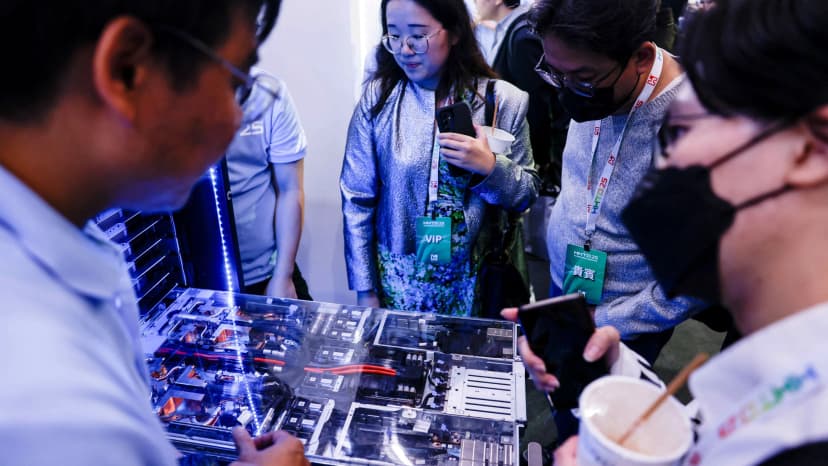
The MSCI Emerging Markets index, including countries like China and India, has risen ten percent since the start of the year, outperforming the stagnant MSCI World index, prompting discussion on investment opportunities in these markets driven by the AI boom and commodity prices.

Consultancy firms are projected to experience their fastest growth in years, fueled by the artificial intelligence boom as companies seek advice on powering data centers and profiting from AI.

Envision founder Zhang Lei says renewables are essential to stop the technology driving up household bills
Former Google CEO Eric Schmidt has raised concerns about the growing electricity demands of artificial intelligence, suggesting the need for space-based data centers, to which Elon Musk humorously responded by referencing his own company.
Kolanovic has indicated a potential rebound in the software sector, attributing this outlook to elevated leverage within the semiconductor industry.
Vinod Khosla says stock prices aren't the way to evaluate AI bubbles. Mert Alper Dervis/Anadolu via Getty Images Vinod Khosla says the rise of AI might warrant steeper taxes on capital and none for most workers. The billionaire VC wrote on X that AI displacing workers could shrink the labor part of the economy. Khosla wrote that some popular tax breaks were "special interest goodies" and not "true capitalism." If artificial intelligence eliminates millions of jobs, it might make sense to scrap income taxes for the vast majority of Americans and target capital instead, Vinod Khosla says. "AI will transform economies and need a rethink of capitalism & equity," the billionaire venture capitalist wrote in an X post on Monday. "Labor portion of economy (vs capital) will decline sharply. Should we eliminate preferential treatment of capital gains tax and equalize to ordinary income?" Khosla — who cofounded Sun Microsystems and made the first VC investment in OpenAI — was making the point that AI replacing labor on a grand scale might warrant greater taxes on assets such as stocks and real estate. The veteran financier, who founded Khosla Ventures after leaving Kleiner Perkins, attached a video highlighting some of the jobs that could be taken by AI, from accountants and therapists to truck drivers and chip designers. AI will transform economies and need a rethink of capitalism & equity. Labor portion of economy (vs capital) will decline sharply. Should we eliminate preferential treatment of capital gains tax and equalize to ordinary income? 40% of capital gains taxes are paid by those with… pic.twitter.com/7oSA9xj5Ko — Vinod Khosla (@vkhosla) February 16, 2026 Khosla said in a follow-up post that ramping up taxes on capital would generate so much revenue that the government could scrap taxes for most of the roughly 150 million US taxpayers. "Could easily eliminate bottom 125 million taxpayers from the tax rolls and be revenue neutral at the same time with a capital gains tax equal to ordinary income and a few other tweaks," he wrote. He added that tax breaks such as carrying over tax losses and tax-free borrowing against unrealized gains — which he called a "true abuse!" — are "special interest goodies inserted by lobbyists and campaign contributions, not true capitalism." Khosla didn't address common critiques of higher taxes, including that they can discourage entrepreneurship and investment, that collecting them can be tricky, and that wealthy people may leave the country to avoid them. Khosla has previously underscored that the advent of AI may require sweeping policy changes. He estimated in late 2024 that in 25 years' time, AI could be doing 80% of the work in 80% of all jobs, and universal basic income might be needed to compensate for job destruction. "As AI reduces the need for human labor, UBI could become crucial, with governments playing a key role in regulating AI's impact and ensuring equitable wealth distribution," he wrote on his firm's website. Khosla isn't alone in predicting AI will change the fabric of society. Elon Musk suggested late last year that work could become "optional" and money might become "irrelevant" if advances in AI and robotics generate abundant resources for all. Moreover, the Tesla and SpaceX CEO recently said that retirement savings may not be needed in 10 or 20 years, as everyone might have "whatever stuff they want." However, skeptics such as Michael Burry of "The Big Short" fame have cautioned the AI boom is a speculative bubble, tech companies are overinvesting in microchips and data centers that will quickly become obsolete, and true AI is further away than many think. Read the original article on Business Insider
The surge in AI development is leading to innovative solutions for powering data centers, including the use of jet engine technology, and significant investments in memory infrastructure to support AI's demands.
AI Boom Creates Blind Spot in Big Tech Accounting - Tech News Briefing - WSJ Podcasts The Wall Street Journal
AI Boom Creates Blind Spot in Big Tech Accounting - Tech News Briefing - WSJ Podcasts The Wall Street Journal
AI Boom Creates Blind Spot in Big Tech Accounting - Tech News Briefing - WSJ Podcasts The Wall Street Journal
AI Boom Creates Blind Spot in Big Tech Accounting - Tech News Briefing - WSJ Podcasts The Wall Street Journal
Former Google CEO Eric Schmidt warns that the United States faces an impending electricity shortage, requiring an additional 92 gigawatts of power to support the rapid growth of AI and its massive data centers.
An article discusses the potential for significant returns from investing in certain AI stocks by 2026, targeting early investors.

An analysis suggests that the artificial intelligence boom will not provide a free pass for major economies struggling with debt, highlighting potential economic challenges.

The world's most valuable company, Nvidia, reported on Wednesday another blockbuster quarterly result that blew past Wall Street expectations, posting record revenue of $68.1...

The global markets are primarily driven today by the boom in Artificial Intelligence. Chip manufacturer Nvidia - known as an industry barometer - once again exceeded expectations with its figures.

President Donald Trump held a White House meeting with major tech companies to discuss strategies for curbing power costs associated with the booming artificial intelligence industry.

AI boom or AI doom?
US datacenters are encountering various challenges, including grassroots protests, as the demand for AI infrastructure grows, highlighting community concerns about the industry's expansion.

The subsea optoelectronics network equipment market reached $337 million during the third quarter of 2025, rising 32.5 per cent from the previous quarter, according to market intelligence firm Omdia. According to the company’s latest report, this market expansion reflected a sharp acceleration driven by the AI infrastructure build-out supercycle. This robust quarterly growth of 32.5 […]
In 2026, the global economic narrative has shifted from the initial excitement of AI to a more calculated and sometimes cautious phase. Citrini Research highlights a move away from the basic hardware race toward "Phase 2" of the AI trade, where the focus lies on operational efficiency and the displacement of high-cost human labor. While corporate margins are expanding through automation and lean structures, there is a growing concern over "Ghost GDP".
Analog chips, which have largely been overlooked in the broader semiconductor rally of the past two years, are now expected to be the next leg of the AI boom.

President Emmanuel Macron stated at the AI Impact Summit in New Delhi that France and the EU are committed to leading global regulation efforts for artificial intelligence with their allies.
AI Boom Creates Blind Spot in Big Tech Accounting - Tech News Briefing - WSJ Podcasts The Wall Street Journal

While AI has driven significant stock market gains, it is now impacting equities sector by sector, with JPMorgan identifying specific stocks that are insulated from these effects.
The U.S. may see a reduced need for lawyers in the age of AI, indicating a broader shift in the job market due to artificial intelligence.
AI Boom Creates Blind Spot in Big Tech Accounting - Tech News Briefing - WSJ Podcasts The Wall Street Journal
AI Boom Creates Blind Spot in Big Tech Accounting - Tech News Briefing - WSJ Podcasts The Wall Street Journal
AI Boom Creates Blind Spot in Big Tech Accounting - Tech News Briefing - WSJ Podcasts The Wall Street Journal
AI Boom Creates Blind Spot in Big Tech Accounting - Tech News Briefing - WSJ Podcasts The Wall Street Journal
AI Boom Creates Blind Spot in Big Tech Accounting - Tech News Briefing - WSJ Podcasts The Wall Street Journal
Companies like Arista Networks and ServiceNow are strengthening their positions in AI, while AMD expands its partnership with Tata in India, challenging Nvidia. Despite some market fears, analysts see buying opportunities in software stocks impacted by AI.