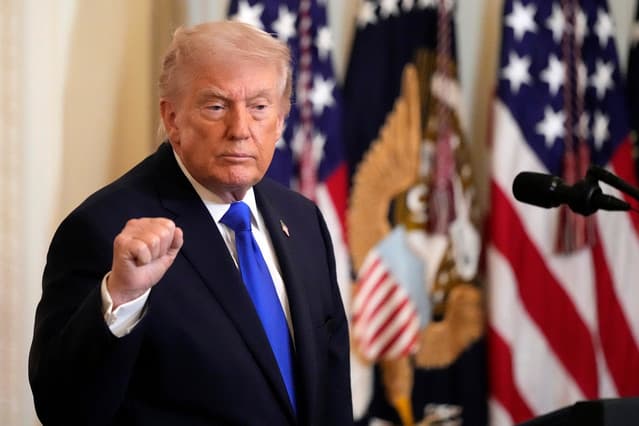
Economist Outlines Trump's Four Scenarios for Military Action Against Iran
The Economist reports on four potential scenarios Donald Trump is considering for military action against Iran, highlighting the complex geopolitical dilemma he faces regarding when and how to proceed, with over a third of the US fleet deployed in the Middle East.

Austrian Economist Marterbauer Discusses Limited Scope for Lowering Non-Wage Labor Costs
Austrian economist Marterbauer states there is little room for reducing non-wage labor costs, indicating a constrained fiscal environment for such measures.

Zelenskyy says there are no divisions in Ukraine's negotiating team: "This is Russian narrative"
President Volodymyr Zelenskyy has denied a report by The Economist about alleged disagreements within Ukraine's negotiating team.
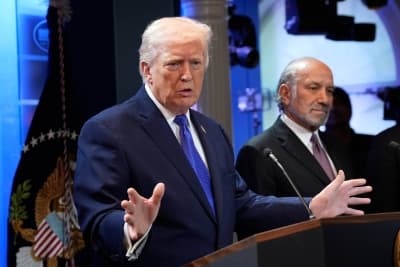
Trump pegs new tariffs to a payments crisis experts doubt exists
Most economists don't believe there is enough evidence that the U.S. can't pay its bills or meet obligations to international investors.

Danish Government's Fiscal Space and Spending
Despite the government's efforts, it is proving difficult to exhaust the 131 billion kroner fiscal space, with economist Thomas Bernt stating there is plenty of money available.

Dramatic Increase in Poverty in Sweden
A Swedish article reports a dramatic increase in the number of Swedes feeling 'seriously poor' compared to four years ago, with economists attributing the rise to inflation and eroded benefits.

Highly Qualified Immigrants in Sweden Protest Strict Migration Laws and Deportations
Highly qualified professionals in Sweden, including economists and engineers, are expressing growing anger over strict migration laws and the deportation of teenagers, citing cases like a daughter being deported despite her family's contributions.

Iran-US Tensions Drive Up Oil Prices
Escalating tensions between the United States and Iran have pushed oil prices higher, despite a recent slight decline. An economist describes the market reaction as emotional rather than indicative of an acute shortage.

'The US Supreme Court decision on tariffs does not end Donald Trump's trade wars'
The economist Sébastien Jean explains in an interview that the US president's decades-old obsession with tariffs is not about to disappear.

What the Supreme Court ruling against Trump tariffs means for your money
The Supreme Court ruled against a centerpiece of President Donald Trump's tariff agenda on Friday. Consumers could save money as a result, economists said.

FinanceAPReutersBBC+5bloombergNPRNHK WorldYahooseeking-alpha3d ago8 sources The economy slowed in the last 3 months of the year -- but was still solid in 2025
The U.S. economy grew 2.2% in 2025, a modest slowdown from 2.4% the previous year. GDP gains were fueled by solid consumer spending and business investment.
ECB Quietly Prepares Global Liquidity Backstop As Euro Debt Wave Builds
ECB Quietly Prepares Global Liquidity Backstop As Euro Debt Wave Builds
Submitted by Thomas Kolbe
Starting in the third quarter of 2026, new rules will apply to the so-called euro repo facility. Central banks worldwide will be able to post up to €50 billion in euro-denominated collateral, such as government bonds, with the ECB in order to obtain euro liquidity from the central bank in cases of acute need. The goal is to guarantee the permanent availability of euro liquidity, replacing the previously time-limited repo lines.
Central banks typically resort to this monetary policy instrument during phases of acute liquidity stress — most recently during the COVID lockdowns. The repo facility counts among the central banks’ immediate crisis tools. The so-called EUREP (Eurosystem Repo Facility for Central Banks) was launched on June 25, 2020, as a short-term liquidity solution for associated central banks: the Central Bank of Kosovo drew €100 million, Montenegro €250 million in short-term liquidity assistance.
Repo auctions generally involve the exchange and short-term pledging of European government bonds for maturities of one to five days, which commercial banks deposit at the central bank in return for liquidity. The collateral is returned after a short period, and the so-called bank reserves are withdrawn again once the liquidity problem has been resolved and the interbank market is functioning properly.
The ECB’s announcement that it will now offer this instrument globally — and over periods of several weeks or even months — raises eyebrows. It suggests that the monetary guardians of the Eurosystem may be anticipating a liquidity crisis in the not-too-distant future.
Euro as a Reserve Currency
The drastic expansion of sovereign debt within the eurozone system may explain why concerns are deepening at the ECB tower. If the two pillars, Germany and France, are each calculating net new borrowing of five percent this year alone — thereby placing a steadily growing volume of bonds on the markets — this generates palpable upward pressure on interest rates. At the same time, investors are asking how strongly the creditworthiness of individual euro states ultimately depends on Germany’s ability to service the mounting debt — a pressure that is manifesting itself in markets.
Interest rates have already been rising for more than three years, particularly at the long end of the bond market. This suggests that confidence among large investors, who traditionally provide the bulk of liquidity in this market, is gradually eroding. Meanwhile, the euro is under pressure internationally: euro-denominated reserves currently account for less than 20 percent of global bank reserves and show a slight downward trend. Similar developments can be observed in the settlement of international transactions, where the euro holds roughly a 24 percent share.
The dominant global actor remains the U.S. dollar, both as a reserve currency with a 59 percent share and in the settlement of international transactions at 47 percent. Against this backdrop, it becomes clear that Europe’s monetary authorities are facing an increasingly challenging combination of rising debt, growing interest rates, and a global environment that does not accord the euro the status of the U.S. dollar — factors that pose serious questions for the Eurosystem’s stability and liquidity.
A severe blow to the euro’s international role was the European Union decision to permanently implement the Russia embargo and halt trade in Russian oil and gas. Russia had been among the few major energy market players willing to allow euro denomination and thus held substantial reserves. That era is over.
However, rumors are circulating that the United States, in the event of a peace settlement in Ukraine, could restore Russia’s access to the SWIFT system. Would the EU then follow suit? A return to the status quo ante might require a different political regime in Brussels and Berlin.
Growing Debt Volume
A fiscal policy U-turn within the EU is also under discussion. Should member states agree on a “two-speed Europe” and implement joint financing of new debt via so-called Eurobonds, this would place the European bond market on an entirely new footing in terms of both volume and structure.
European taxpayers — above all the still relatively less indebted Germans at the federal level — would then stand behind the credit guarantees. In Frankfurt, such a revolutionary step is expected to deliver a massive boost in global demand for euro-denominated bonds.
One unknown in the geopolitical power struggle remains the Federal Reserve. On several occasions last year, the ECB warned of a possible shortage of U.S. dollars within the European banking system. The United States holds a powerful lever here: it can drive up the political price of bridging potential illiquidity through rapid swap lines — short-term loans within the dollar system to European banks and the ECB.
Oversupply of Euro Bonds
The Eurosystem thus faces immense absorption problems. If global demand for EU debt — that is, euro bonds — cannot be generated, interest rates will continue to rise. In light of the massive issuance wave of new euro sovereign bonds, the ECB would be forced to take this debt onto its own balance sheet to keep debt servicing in member states under control.
The expansion of the repo facility into a permanent liquidity backstop therefore appears plausible. Global central banks would have an incentive to accumulate a growing share of euro bonds. Moreover, the volume would be available to gain direct access to the Eurosystem without assembling a portfolio of bonds from individual states. Germany’s relatively low debt level had in fact recently been a problem, as insufficient tranches of German federal bonds were available for larger capital allocations. Chancellor Friedrich Merz and his finance minister are currently eliminating this issue with their present debt policy.
The ECB’s measures thus fit into a broader fiscal policy development that could culminate in a structural expansion of joint debt. By institutionally safeguarding international demand for euro bonds, the central bank is creating the infrastructural preconditions for a potential new debt regime within the European Union — while simultaneously shifting the boundary between monetary stabilization and fiscal support of state budgets.
The European repo facility, once conceived as a rescue umbrella for liquidity problems, is gradually evolving into a classic, expanding debt pool. With eurozone government debt likely to rise from the current 92 percent of GDP to around 100 percent over the next two years, pressure on the ECB to devise mechanisms for distributing this flood of debt across global bond markets will intensify.
Whether this succeeds appears highly doubtful given the euro economy’s chronic economic weakness.
* * *
About the author: Thomas Kolbe, a German graduate economist, has worked for over 25 years as a journalist and media producer for clients from various industries and business associations. As a publicist, he focuses on economic processes and observes geopolitical events from the perspective of the capital markets. His publications follow a philosophy that focuses on the individual and their right to self-determination.
Tyler Durden
Fri, 02/20/2026 - 08:30
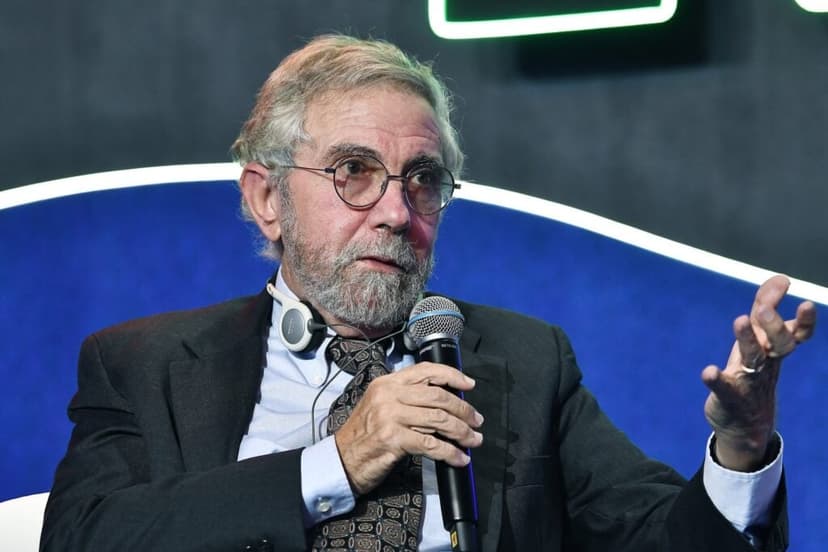
Trump's 'Destructive Policy' On Clean Energy Reflects 'Corrupting Influence' Of Big Money Seeking To Block Electrotech Transition, Says Paul Krugman
Economist Paul Krugman has criticized former President Trump's clean energy policies, calling them 'destructive' and influenced by 'corrupting' big money interests seeking to hinder the electrotech transition.

Fund Freezes Withdrawals, Drawing Bear Stearns Parallels
A fund that has announced it will no longer allow withdrawals is drawing comparisons to the Bear Stearns crisis from economist Mohamed El-Erian.
Saudi Arabia and UAE Urged to Resolve Differences Amid US Neglect
The Economist suggests that Saudi Arabia and the Emirates must resolve their own differences, noting that America's neglect is allowing unwelcome tension to fester between two of its allies.
Economist Argues Against Targeting the Rich to Fix Budgets
An article in The Economist argues that attempting to fix broken national budgets by targeting the wealthy is both ineffective and wrong in principle.
WH Adviser Hassett Urges 'Discipline' for Fed Economists on Tariff Study
White House adviser Hassett has called for 'discipline' among Federal Reserve economists regarding their study on tariffs, suggesting potential political pressure on economic analysis.

Panics, Politics, & Power: America's 3 Experiments With Central Banks
Panics, Politics, & Power: America's 3 Experiments With Central Banks
Authored by Andrew Moran via The Epoch Times,
The Federal Reserve, established more than a century ago, is the United States’ third experiment with central banking.
For much of its existence, the institution maintained a low public profile.
Only after the 2008 global financial crisis did the Fed begin communicating more openly, introducing post-meeting press conferences and allowing monetary policymakers to engage more frequently with the media.
Greater transparency, however, has brought greater scrutiny.
Public sentiment toward the Fed and its leadership has fluctuated over the years. Today, YouGov polling suggests the central bank is viewed favorably by 44 percent of Americans and unfavorably by 18 percent.
If the Fed pursues a series of reforms, it will have “another great 100 years,” said Kevin Warsh, who was nominated by President Donald Trump to serve as the institution’s next chair.
Comparable to past central banks, Warsh said, the current Federal Reserve System is beginning to lose the consent of the governed.
“You can think about the Jacksonians of prior times say that the central bank seems like they’re trying to focus and they’re all preoccupied with those special interests on the East Coast, and they’ve lost track of what’s happening to us in the center of the country,” Warsh said in a July 2025 interview with the Hoover Institution’s Peter Robinson.
“It’s a version of what worries me today.”
What happened in the past, and why is it relevant to today’s central bank?
The First Bank of the United States
In the aftermath of the American Revolution, the United States faced a series of immense economic disruptions, forcing the nation’s architects to rebuild the economy.
The objective was to lower inflation, restore the value of the nation’s currency, repay war debt, and revive the economy.
Alexander Hamilton, the first secretary of the Treasury under the new Constitution, proposed establishing a national bank modeled on the Bank of England. Hamilton stated that a U.S. version would perform various duties, including issuing paper money, serving as the government’s fiscal agent, and protecting public funds.
Not everyone shared Hamilton’s ebullience over a central bank.
Thomas Jefferson, for example, feared that such an institution would not serve the nation’s best interests. Additionally, Jefferson and other critics argued that the Constitution did not grant the government the authority to create these entities.
Nevertheless, Congress enacted legislation to establish the Bank of the United States. President George Washington then signed the bill in February 1791.
Two of America's founding fathers: Thomas Jefferson (L) and Alexander Hamilton. The White House
While bank officials did not conduct monetary policy as modern central banks do, they did influence the supply of money and credit, as well as interest rates.
The entity managed the money supply by controlling when to redeem or retain state‑bank notes. If it sought to tighten credit, it would require payment in gold or silver, thereby draining state banks’ reserves and limiting their ability to issue new notes. If it wanted to expand credit, it simply held on to those notes, boosting state‑bank reserves and enabling them to lend more.
By 1811, the national bank’s charter expired.
While there had been discussions of allowing it to continue maintaining operations, Congress—both chambers—voted against renewing its mandate by a single vote.
Its closure came shortly before the War of 1812, which fueled inflation and weakened the currency.
Second Bank of the United States
Lawmakers believed another central bank was critical at a time of fiscal, inflationary, and trade pressures.
Congress used a similar 20-year model to produce the Second Bank of the United States, headed by Nicholas Biddle. The second incarnation had a federal charter, was privately owned, and was tasked with regulating state banks (with gold and silver for note redemption).
President James Madison, who opposed the first central bank on constitutional grounds, supported the new institution out of financial necessity.
Its creation stabilized credit and brought down inflation. However, by the 1830s, the bank faced strong opposition, particularly from President Andrew Jackson.
Labeled the Bank War, Jackson engaged in a years-long initiative to dissolve the central bank.
Jackson claimed the national bank was a tool for the wealthy eastern elite and a threat to self-government.
“The Jacksonians described themselves as conscious hard-money men who supported the rigid discipline of the gold standard, yet they opposed the newly powerful national Bank because it restrained the expansion of credit and, thus, thwarted robust economic expansion,” author William Greider wrote in “Secrets of the Temple.”
In 1832, Jackson vetoed legislation to recharter the bank four years early, delivering a fiery message that historians say was one of the most important vetoes in the nation’s history.
“It is to be regretted that the rich and powerful too often bend the acts of government to their selfish purposes. Distinctions in society will always exist under every just government,” Jackson wrote.
“There are no necessary evils in government. Its evils exist only in its abuses. If it would confine itself to equal protection, and, as Heaven does its rains, shower its favors alike on the high and the low, the rich and the poor, it would be an unqualified blessing. In the act before me, there seems to be a wide and unnecessary departure from these just principles.”
The charter expired in 1836, leading to the panic of 1837.
An economic crisis unfolded, leading to bank failures, business bankruptcies, rising unemployment, and contracting credit. While the collapse of the central bank is often considered a leading cause, the British also urged London banks to reduce credit to American merchants, causing a sharp drop in global trade.
As the smoke cleared and dust settled, it was not until the 1840s that the United States embarked on a historic economic recovery, now known as the Free Banking Era.
Banking was decentralized, and finance was largely unregulated. Despite an erratic financial system, the U.S. economy grew rapidly: agricultural production accelerated, railroads were built, and the country expanded westward. Additionally, deflation was paramount throughout most of the economic expansion.
The Federal Reserve System
The panic of 1907 led to the creation of the Federal Reserve System.
Following years of heavy borrowing, speculative commodities investments (mainly copper), and enormous stock market gains, a financial crisis was brewing. The event nearly brought down the U.S. banking system.
J.P. Morgan, a financier, intervened and emulated the actions of modern central banks. He met with the nation’s top bankers, facilitated emergency loans to financial institutions, and backed stockbrokers. The damage had been done as the United States fell into a year-long recession, marked by high unemployment and widespread bank failures.
The Federal Reserve Board of Governors seal in Washington on Oct. 29, 2025. Madalina Kilroy/The Epoch Times
Washington realized that it could not rely on private bailouts to prevent sharp downturns.
Sen. Nelson Aldrich (R-R.I.) is widely regarded as one of the chief architects of the modern Federal Reserve System.
In 1910, Aldrich hosted the famous Jekyll Island meetings, a gathering of U.S. officials and bankers, to discuss the blueprint of a new central bank.
While the initial draft laid the foundation for the institution, the official Federal Reserve Act was drafted by President Woodrow Wilson, Rep. Carter Glass (D-Va.), and H. Parker Willis, an economist on the House Banking Committee.
The new system was a public-private hybrid, with the federal government firmly in charge, and bankers running the regional reserve banks.
“It was Wilson’s great compromise,” wrote Greider, “creating a hybrid institution that mixed private and public control, an approach without precedent at the time.”
The legislation triggered a contentious political debate over the extent of its independence from the Treasury and the degree of authority delegated to policymakers over currency issuance.
Days before Christmas, the bill cleared both chambers and was signed into law by Wilson on Dec. 23.
“Wilson’s conviction that he had struck the right moderate balance seemed confirmed, however, by the reactions to his legislation,” Greider noted.
“It was attacked by both extremes—the ‘radicals’ from the Populist states and the bankers in Wall Street and elsewhere.”
Since its inception in 1913, the modern Federal Reserve has undergone numerous changes and has gained greater power.
The New Deal, for instance, allowed the Fed to become the lender of last resort as Washington learned the central bank could not prevent bank failures.
In 1951, the Treasury-Fed Accord restored central bank independence after the Federal Reserve had been forced to keep interest rates artificially low throughout the Second World War.
Congress then enacted the Federal Reserve Reform Act in 1977, establishing the dual mandate of promoting maximum employment and maintaining price stability.
2026 and Beyond
Over the past 50 years, the Fed has undergone modest changes, including the issuance of forward guidance and the disclosure of emergency lending facilities.
But while each new regime has nibbled around the edges, Warsh has suggested he could effect substantial reforms at the central bank.
“Until there’s regime change at the Fed and new people running the Fed, a new operating framework, they’re stuck with their old mistakes,” Warsh told Fox Business Network in October 2025.
“Bygones aren’t just bygones.”
Tyler Durden
Wed, 02/18/2026 - 16:20

Analysis Reveals Consumers Bear the Cost of US Tariffs
A new analysis indicates that consumers are ultimately responsible for paying US tariffs, a finding that has surprised some economists.

FinanceYahooseeking-alpha6d ago2 sources El-Erian Predicts High Volatility for U.S. Economy
Economist El-Erian forecasts significant volatility for the U.S. economy moving forward.

Futures, Global Markets Rise With US Markets Closed For President's Day
Futures, Global Markets Rise With US Markets Closed For President's Day
Stocks gained, bitcoin tumbled and bonds steadied after Friday's cool CPI data reinforced expectations that the Fed will cut interest rates on multiple occasions this year. With US markets closed for the Presidents’ Day holiday and mainland China’s markets closed for Lunar New Year holidays, trading was muted on Monday. As of 9:00am ET, futures on the S&P 500 added 0.4% and Europe’s Stoxx 600 index rose 0.4% as banking shares rebounded from a sharp decline last week. German bunds and Treasury futures were steady after US yields touched the lowest since December on Friday.
The path of US interest rates remains in focus following Friday’s slower-than-expected US inflation print as traders fully price a Fed cut in July and the strong chance of a move in June.
“The backdrop for equities is positive post CPI,” said Andrea Gabellone, head of global equities at KBC Securities. At the same time, there could be “more dispersion ahead as sentiment around key AI-exposed sectors is still very critical,” he added.
That sentiment was echoed by other strategists seeking to distinguish between AI losers and winners.
A JPMorgan Chase & Co. team led by Mislav Matejka urged caution on stocks at risk of AI-driven “cannibalization,” including software, business services and media companies. Meanwhile, banks are developing baskets to capitalize on the divergence: as we first reported last Thursday, Goldman launched a new basket of software stocks that goes long firms that will benefit from AI adoption, while shorting the companies whose workflows could be replaced.
With AI disruption rippling through markets, a lot will come down to earnings resilience, in particular in the US.
“When you look at the current earnings season, the companies are showing 13% of growth,” Nataliia Lipikhina, head of EMEA equity strategy at JPMorgan, told Bloomberg TV. “Overall, this is the reason why we continue to be positive on the S&P.”
Later this week, traders will be watching for ADP private payrolls numbers on Tuesday and the minutes from the Fed’s January meeting on Wednesday for a fresh read on the economy.
European stocks gained with bank shares rebounding, after posting their biggest weekly decline since April on worries about disruption from artificial intelligence. The basic resources sector lags, with Norsk Hydro among Europe’s worst performers as both Goldman Sachs and RBC downgrade the stock. Stoxx 600 rises 0.4% to 620.26 with 253 members down, 336 up, and 11 unchanged. Here are some of the biggest movers on Monday:
NatWest shares rise as much as 4%, the most since October, as Citi analyst Andrew Coombs raises his price target on the UK bank to a Street-high.
Seraphim Space shares rise as much as 9.2%, briefly hitting a new all-time high, after the space tech investment firm said the valuations of its four largest holdings increased over the final months of 2025.
AECI shares rally as much as 6.1%, the most since July, after the South African commercial-explosives maker shared improved 2025 headline earnings per share guidance.
Orsted shares rise as much as 3.8% after analysts at Kepler raise the recommendation to buy from hold over the Danish renewable energy firm’s outlook, despite ongoing uncertainty for the industry in the US.
Norsk Hydro shares fall as much as 4.4%, extending Friday’s 5.9% earnings-triggered drop, after being downgraded at Goldman Sachs and RBC over disappointments and pricing pressures in the Norwegian aluminum company’s downstream business.
Galderma shares slip as much as 2.2% after naming Luigi La Corte as its new chief financial officer following the news back in July that Thomas Dittrich was departing.
Pinewood Technologies shares tumble as much as 32%, the most since April 2024, after Apax Partners said on Friday it will not proceed with a possible cash offer for the car dealership software provider.
FlatexDEGIRO shares drop as much as 7.2% after BNP Paribas downgraded the online brokerage firm to neutral from outperform, saying the price reflects too much optimism about its market position in Germany.
Maurel & Prom shares slump as much as 12%, pulling back after ending last week at a 2015-high, after announcing it is not currently authorized to resume oil and gas operations in Venezuela.
Barratt Redrow shares fall as much as 3.7%, leading a drop in British homebuilders after Rightmove said house prices are stalling.
Asian stocks slipped for a second day, led by declines in Japan as traders booked profits after last week’s post-election rally. Several markets were closed or held shortened trading sessions for the Lunar New Year holiday. The MSCI Asia Pacific Index was down 0.1%. Japan’s Topix Index fell 0.8%, with Mizuho Financial Group Inc. and Toyota Motor Corp. among the companies contributing to the index’s losses.In Hong Kong, AI model developer Minimax Group Inc. surged as much as 30% to more than four times its original listing price, while competitor Knowledge Atlas JSC Ltd. ended 4.7% higher. The market will be closed until Thursday. As investors across the region begin to reevaluate their bets on its artificial-intelligence-driven rally, traders in Japan cashed in gains driven by expectations of Prime Minister Sanae Takaichi’s proactive spending policies last week.Trading in Singapore ended early Monday and will be shut until Wednesday. Equity markets in mainland China, South Korea, Indonesia and Vietnam were closed.
In FX, the yen is the notable mover in currencies, weakening 0.5% against the dollar and pushing USD/JPY back above 153. The offshore yuan is one of the better performers against the greenback. The Bloomberg Dollar Spot Index rises 0.1%.
There is no cash trading in Treasuries due to the Presidents’ Day holiday. European government bonds are little changed
In commdities, gold dipped below $5,000 an ounce, as traders booked profits from a gain in the previous session. Bitcoin tried anf ailed to stage a modest rebound; it last traded around $68,275 after posting its fourth consecutive weekly loss, with the cryptocurrency struggling to find clear direction as a weekend rally fizzled once the momentum ignition algos emerged. WTI crude futures tread water near $62.90 a barrel.
Top Headlines
President Trump said there will be voter ID rules in the mid-term elections this year, whether Congress approves it or not, and they will present a legal argument in an Executive Order. Furthermore, Trump said he has searched the depths of legal arguments not yet articulated nor vetted on this subject, and they will be presenting an irrefutable one in the very near future.
Iran says potential energy, mining and aircraft deals on table in talks with US: RTRS
Pentagon threatened to cut its ties with Anthropic over the company’s insistence that some limitations are kept on how the military uses its AI models: RTRS
UK eyes rapid ban on social media for under 16s, curbs to AI chatbots: RTRS
Rampant AI Demand for Memory Is Fueling a Growing Chip Crisis: BBG
Warner Bros. Weighs Reopening Sale Negotiations With Paramount: BBG
Companies Are Replacing CEOs in Record Numbers—and They’re Getting Younger: WSJ
Europe aims to rely less on US defence after Trump's Greenland push: RTRS
DOJ Tells Lawmakers Epstein File Redactions Complied With LawL BBG
For College Applicants, Pressure to Make Summers Count Has Gotten Even Worse: WSJ
Fed's Goolsbee (2027 voter) said on Friday that they are still seeing pretty high services inflation, and he hopes they have seen the peak impact of tariffs, while he added that the job market has been steady, with only modest cooling.
The Break Is Over. Companies Are Jacking Up Prices Again: WSJ
Trade/Tariffs
USTR Greer said the US and Ecuador expect to sign a trade agreement in the coming weeks.
China will waive import value-added taxes on selected seeds, genetic resources, and police dogs through to 2030 to increase agricultural competitiveness and breeding capacity. It was also reported that China will grant zero-tariff access to 53 African nations from May 1st, according to Bloomberg.
Chinese Foreign Minister Wang Yi told his French and German counterparts that China and the EU are partners, not rivals, while he added that China and the EU should manage differences, deepen practical cooperation and work together on global challenges.
A more detailed look at global markets courtesy of Newsquawk
APAC stocks began the week in the green but with gains limited following a lack of major fresh catalysts from over the weekend and amid thinned conditions owing to holiday closures in the region and North America. ASX 200 traded marginally higher with upside led by tech, although gains are capped by underperformance in the utilities, mining, materials and resources sectors, while participants also digested a slew of earnings releases. Nikkei 225 traded indecisively with the index constrained by disappointing Japanese preliminary Q4 GDP data, which showed the economy returned to growth but failed to meet expectations with GDP Q/Q at 0.1% (exp. 0.4%), and annualised GDP at 0.2% (exp. 1.6%). Hang Seng finished higher in a shortened trading session on Chinese New Year's Eve but with upside limited by tech weakness amid some confusion after the Pentagon added several companies including Baidu, Cosco, BYD, Huawei, Nio, SMIC, Tencent, and more to a list of Chinese firms aiding the military on Friday, but then withdrew the updated list shortly after it was posted. Furthermore, price action was also restricted by the closure of mainland markets and the absence of stock connect flows, which will remain shut for more than a week. US equity futures kept afloat in quiet trade amid the absence of drivers and participants. European equity futures indicate a mildly positive cash market open with Euro Stoxx 50 futures up 0.1% after the cash market closed with losses of 0.4% on Friday.
Asian Headlines
Chinese President Xi called for the anchoring of economic growth around domestic demand as its main driver, in a speech during a key policy meeting late last year that was released on Sunday.
China is to establish a permanent financial support framework to promote rural revitalisation and prevent a slide back into poverty, which represents a shift from transitional aid to long-term support.
China’s market regulator summoned major online platform companies on Friday, including Alibaba, Douyin and Meituan, while it directed them to comply with laws and regulations, and rein in promotional practices, according to Bloomberg.
US Secretary of State Rubio and Japanese Foreign Minister Motegi reaffirmed their commitment to deepen bilateral ties.
Disney (DIS) sent a ‘cease and desist’ letter to ByteDance over Seedance 2.0 and alleged that ByteDance has been infringing on its IP to train and develop an AI video generation model without compensation, according to Axios. It was later reported that ByteDance said it would curb its AI video app following Disney's legal threats, according to the BBC.
RBI tightened rules for loans provided to brokers and proprietary firms in an effort to reduce market speculation
FX
DXY eked slight gains in rangebound trade after a lack of major catalysts and with US participants away on Monday.
EUR/USD was little changed amid the absence of any major macro catalysts and with light newsflow from the bloc, while comments from ECB President Lagarde and news that the ECB is to make its repo backstop available to other central banks across the world, did little to spur price action.
GBP/USD held on to most of Friday's spoils but with price action contained by resistance around 1.3650 and following comments from BoE's Mann that the UK economy is sluggish and tepid, with consumers spending less due to being scarred by high inflation.
USD/JPY edged higher and returned to above the 153.00 level in the aftermath of the weaker-than-expected preliminary Q4 GDP data for Japan.
Antipodeans were mixed with little fresh macro drivers and a lack of tier-1 data from either side of the Tasman.
Fixed Income
10yr UST futures traded little changed and held on to last week's spoils after returning above the 113.00 level in the aftermath of the softer US inflation data, while price action was contained to start the week by the closure of US cash markets for Washington's Birthday.
Bund futures lacked demand in the absence of any major catalysts and with light newsflow from the bloc.
10yr JGB futures were marginally higher following disappointing preliminary GDP data for Q4, but with gains limited after failing to sustain a brief reclaim of the 132.00 level.
Commodities
Crude futures were rangebound amid light energy-specific newsflow from over the weekend and after last Friday's indecisive performance, where attention was on a source report that noted OPEC+ is leaning towards resuming oil output hikes from April, but with no decision made.
Slovak PM Fico said he has information that the Druzhba pipeline has been fixed after damage in Ukraine, although he believes that supplies to Hungary and Slovakia have become a part of political blackmail.
Spot gold took a breather after edging higher in the aftermath of the recent softer-than-expected US inflation data, with price action also contained by the holiday closures across Asia and North America.
Copper futures were subdued, with their largest buyer away for more than a week due to the Chinese New Year/Spring Festival holiday.
Texas venture-backed startup Hertha Metal vowed mass production of steel with 25% cost savings, which could reduce US reliance on imports.
Geopolitics: Middle East
US military is preparing for potential operations against Iran that could last for weeks if US President Trump orders an attack and the US fully expects Iran to retaliate, according to sources cited by Reuters.
US President Trump told Israeli PM Netanyahu during a meeting in December that he would support Israel striking Iran’s ballistic missile program if the US and Iran are not able to reach a deal, according to CBS.
Iran confirmed that indirect talks between the US and Iran will resume in Geneva on Tuesday under the mediation of Oman, while Iranian Foreign Minister Araghchi left for Geneva on Sunday.
Iranian diplomat said Iran is open to nuclear deal compromises if the US discusses lifting sanctions, while it was also reported that Iran said potential energy, mining and aircraft deals are on the table in talks with the US.
Israel’s cabinet approved the proposal to register West Bank lands as ‘state property’, while Palestinians condemned the ‘de facto annexation’ which Peace Now said likely amounts to a ‘mega land grab’.
Geopolitics: Ukraine
US President Trump said on Friday that Ukrainian President Zelensky is going to have to get moving and that Russia wants to get a deal.
US Secretary of State Rubio said they don’t know if Russia is serious about finding an end to the war in Ukraine and will continue to test it, while it was reported that he met with Ukrainian President Zelensky on security and deepening defence and economic partnerships.
Ukrainian drones targeted Russia’s Taman seaport and fuel tanks in the Black Sea region.
UK and European allies were reported on Friday to be weighing seizing Russian shadow fleet ships and tightening curbs on Russia's economy.
French Foreign Minister Barrot said some G7 nations have expressed a willingness to proceed with a maritime services ban on Russian oil, which they hope to include in the 20th sanctions package that they are actively preparing.
Geopolitics: Other
European Commission President von der Leyen said that they face the very distinct threat of outside forces trying to weaken their union, while she added that mutual defence is not an optional task for the European Union; it is an obligation within their own treaty, and it is their collective commitment to stand by each other in case of aggression.
Pentagon said the US military struck an alleged drug cartel boat in the Caribbean, which killed three people.
DB's Jim Reid concludes the overnigt wrap
I hope you all had a good weekend. To stay in Winter Olympics mood the family watched "Cool Runnings" last night. I haven't seen it for 32 years. Please don't tell anyone but I had a few tears in my eyes at the end. I blamed it on the hay fever that has now started.
There will be a lot of tears out there in markets for other reasons at the moment. Just two weeks ago, the idea of AI-driven disruption still felt like an abstract, almost academic thought experiment—something we could safely revisit once we had clearer evidence of how AI would be deployed and integrated across the economy. Fast forward 14 days, and markets have wiped out well over a trillion dollars of global equity value on the fear that AI could fundamentally reshape business models and compress profitability across a wide range of industries, including software, legal services, IT consulting, wealth management, logistics, insurance, real estate brokerage and commercial real estate.
Some of the sell off in “old economy” sectors feels overdone to me. But as I argued in our 2026 World Outlook back in November, the real challenge is that even by the end of this year we still won’t have enough evidence to identify the structural winners and losers with confidence. That leaves plenty of room for investors’ imaginations—both optimistic and pessimistic—to run wild. As such big sentiment swings will continue to be the order of the day.
My instinct is that the reaction in things like commercial real estate, for example, has been particularly exaggerated. Markets seem to be extrapolating a scenario in which vast numbers of white collar workers are made redundant almost overnight, leading to a dramatic collapse in office demand. If that view turns out to be correct, we’ll be facing societal challenges far larger than anything currently being priced into equities. While trying to catch a falling knife may be too risky for many, beginning to cushion the descent could be sensible in many old economy sectors. Markets can’t sustain a disruption narrative across multiple sectors for months or quarters without concrete evidence — and that evidence is likely to take much longer to emerge. Fascinating times.
As for this week, today is a US holiday but inflation will remain in the spotlight at a global level after Friday's slightly softer US CPI which helped contribute to a decent rates rally to end the week. Prints are due in the US (PCE - Friday), the UK (Wednesday), Canada (Tuesday) and Japan (Friday). Other economic highlights will include the FOMC minutes (Wednesday), Q4 GDP in the US (Friday), as well as the global flash PMIs (Friday). Earnings reports will feature Walmart (Thursday), Nestlé (Thursday) and BHP (today). It's the earnings calm before next week's Nvidia storm.
In the US, this holiday shortened week (President's Day today) features a data calendar dominated by releases that were pushed back by last year’s government shutdown. The most consequential updates will land on Friday, when the advance estimate of Q4 GDP arrives alongside December’s personal income and consumption figures—key inputs for shaping expectations for the early part of this year.
For markets assessing the underlying pulse of demand heading into 2026, private final sales to domestic purchasers (PFDP) will carry more weight than the headline GDP print. This indicator—closely monitored by Fed Chair Powell—is expected by our economists to slow to 2.0% from 2.9% in Q3, though risks appear tilted upward. One swing factor: Wednesday’s durable goods report, where modest gains outside of transportation could soften the deceleration. On the consumer front, real PCE growth is expected to cool to 2.5% after two quarters of outsized strength but should still signal ample momentum heading into the new year.
Friday’s income and spending report will also offer the latest reading on core PCE, the Fed’s preferred inflation gauge. Our economists expect another 0.4% monthly increase for December, lifting the year over year rate to 2.9%. Updated seasonal factors from last week’s CPI release suggest some mild downward pressure on inflation trends in the second half of 2025. Still, January’s CPI data, although softer than we anticipated, do not translate into equivalent relief for core PCE—in fact, our team currently sees another 0.4% gain for January's release (delayed until March 13th). Depending on the strength of medical services, airfare, and portfolio management components in the upcoming PPI report, a 0.5% monthly rise cannot be ruled out, which would push the year over year rate toward 3.1%. So don't get too excited about the softer CPI last week and the huge rates rally.
Additional releases this week will help clarify whether recent severe winter weather has disrupted factory sector activity. January industrial production, due Wednesday, should benefit from a jump in utility output, while weather effects may weigh on the Empire State Survey tomorrow and the Philadelphia Fed survey on Thursday.
Labor market data will also be in focus, particularly Thursday’s jobless claims, which line up with the survey week for the February employment report. As our economists have pointed out, private nonfarm job gains have averaged 103k over the past three months, slightly above the pace at this point in 2025 and matching the start of 2024. See their latest US employment chartbook here.
This week will also feature a dense lineup of Federal Reserve speakers which you can see alongside all the key global data in the day-by-day week ahead calendar at the end as usual.
Moving away from the US, inflation will also be in focus in Japan (Friday) and Canada (tomorrow). For the former, our Chief Japan Economist sees the January nationwide CPI showing a slowdown in both core CPI inflation ex. fresh food to 2.1% YoY (+2.4% in December) and core-core CPI inflation ex. fresh food and energy to 2.7% (+2.9%). Also important will be the global flash PMIs due on Friday as a health check on global growth. In Europe, the spotlight will be on UK inflation (Wednesday), with labour market data due tomorrow and retail sales on Friday. Our UK economist expects headline CPI inflation to drop to 3.0% YoY (3.4% in December) and core CPI also landing at 3.0% YoY (3.2% YoY). See more in his full preview here. In terms of key rate decisions, the RBNZ are expected to remain on hold on Wednesday.
Finally, the Munich Security Conference wrapped up over the weekend, where key topics included Ukraine, Russia, and the fate of Greenland. And while US Secretary of State Marco Rubio’s speech was nothing like Vice President JD Vance’s at last year’s conference, which triggered a “wake-up” call for European leaders, Rubio reiterated the administration’s view that Europe needed to leave behind its focus on energy policies, trade and mass migration.
Recapping last week now, the tech volatility that has dogged markets since the start of the month broadened into a far more indiscriminate sell-off. The trough came on Thursday, marked by a sharp drop in software stocks, but the weakness extended well beyond tech. Companies across wealth management, real estate and financials suffered double digit declines, underscoring how widespread the pullback has become. Market breadth confirmed this shift as the equal weighted S&P 500 fell -1.37% on Thursday, though it managed to finish the week up +0.29% (+1.04% on Friday). Ultimately, the sell-off left the major US indices on the back foot: the S&P 500 slipped -1.39% (+0.05% on Friday), the Nasdaq lost -2.10% (-0.22% on Friday), and the Magnificent 7 slid -3.24% (-1.11% on Friday).
Although the AI scare dominated sentiment, a heavy slate of US data also shaped the market narrative. Early in the week, softer prints—including flat December retail sales, a dovish Q4 Employment Cost Index, and slower Q4 growth expectations from the Atlanta Fed—pushed Treasury yields lower across the curve. That picture shifted midweek after a stronger than expected January jobs report, which delivered the largest gain in nonfarm payrolls (+130k vs. +65k expected) since December 2024 and reinforced confidence that the US economy carried solid momentum into 2026. Then on Friday, January CPI came in below expectations, adding another dovish note. Although the data offered mixed signals at times, the overall takeaway was sufficiently dovish for traders to increase the number of expected rate cuts by December 2026 to 63.4bps (+7.7bps on the week). This helped drive the largest weekly drop in the 10 year Treasury yield since August 2025, down -15.8bps (-5.0bps on Friday) to 4.05%. The 2 year yield also moved sharply lower, falling -8.9bps to 3.41% (-4.8bps on Friday), its lowest level since 2022.
European markets, meanwhile, delivered a comparatively resilient performance. The STOXX 600 (+0.09%, -0.13% Friday), DAX (+0.78%, +0.25% Friday) and FTSE 100 (+0.74%, +0.42% Friday) all posted modest gains for the week. European sovereign bonds rallied as well, with the 10 year bund yield dropping -8.7bps—its steepest weekly decline since April 2025. That move was outpaced by gilts, which fell -9.8bps (-3.6bps on Friday) despite a sharp early week sell-off triggered by renewed questions surrounding Prime Minister Keir Starmer’s position.
Elsewhere, performance was mixed. Brent crude edged down -0.44% (+0.34% on Friday), while gold extended its upward run, rising +1.56% (+2.43% on Friday).
Will London’s half term week finally give us a quiet week in 2026? You’d probably have to guess at ‘unlikely’.
Tyler Durden
Mon, 02/16/2026 - 09:40
Economists Cautiously Optimistic About Soft Landing for the Economy
The economy appears to have achieved a soft landing, though experts remain cautious about jinxing the positive outlook.

Bank of England Chief Economist Urges Caution on Interest Rate Cuts
Huw Pill, the Bank of England's chief economist, has advised caution regarding further interest rate reductions, pushing back against more dovish calls from other members of the Monetary Policy Committee.
The Economic Imperative of Valuing Human Life
An economist discusses the seemingly morbid but necessary practice of assigning a monetary value to human life for policy decisions, arguing it's better than the alternative.

Politicseconomistwapodelo+2iefimeridaseeking-alpha6h ago5 sources Pentagon Flags Risks of Prolonged Iran Strike as Trump Weighs Options
The Pentagon has reportedly flagged the risks associated with a prolonged strike against Iran, as President Trump considers various military options.

Municipal Elections 2026: In Bordeaux, former footballer Johan Micoud appears on Philippe Dessertine's list
The former Girondins star commits to the economist, an 'independent' candidate for the municipal elections in Bordeaux.

Poland's Retail Sales Exceed Economist Forecasts in January
Retail sales in Poland grew by 4.4% year-on-year in January (at constant prices), surpassing economists' average forecasts, according to the Central Statistical Office.
UAE as an Island of Certainty and Stability
A top economist has described the UAE as an 'island of certainty and stability' amidst an uncertain and volatile global landscape.

Finnish Economist Highlights 'Ugly' National Economic and Population Statistics
Economist Stina Oksa, who advises the Finnish government, uses TikTok to draw attention to under-discussed "ugly" population and economic statistics affecting Finland.

Financedigi24Times of Indiahindustan-times+1dh-les-sports1d ago4 sources Trump issues directive imposing ‘import surcharge’, ends ‘certain tariff actions’: What they mean
Trump’s latest order on tariffs came after the landmark Supreme Court ruling that trashed some of his sweeping tariffs and said they violated federal law.

Francesca Bria Warns of Tech Oligarch Threat to Democracy
Economist and digital policy expert Francesca Bria discusses in an interview how tech oligarchs pose a threat to democracy and the impact of new technologies on information media.

PoliticsAPBBCNYT+10wsjwapoThe GuardianNPRSCMPFrance 24marketwatchforbesTimes of Indiaseeking-alpha2d ago13 sources Handing defeats to Trump, Supreme Court signals potential course change
A pair of rulings on tariffs and National Guard deployment mark the justices’ first major decisions against the president. More may be coming.

Luxembourg Considers Universal Basic Income to Mitigate AI's Impact on Employment
Luxembourg is exploring the potential benefits of a universal basic income as politicians, economists, and unions seek ways to cushion the impact of artificial intelligence on the workforce.
‘The policy backdrop is just so much more supportive for growth this year’ – BofA’s senior economist
Bank of America's senior economist expresses a positive outlook for economic growth in 2025, citing a supportive policy backdrop.

Food Prices Have Greater Impact on Estonian Inflation Than Imagined
An economist highlights that food price movements have a disproportionately larger impact on Estonian families and consumer behavior compared to wealthier countries, where food constitutes a smaller share of total spending.

FinanceBusiness Insiderseeking-alpha3d ago2 sources SCOTUS ruling could put over $175B in U.S. tariff revenue at risk, Penn-Wharton estimates
Nobel laureate Joseph Stiglitz forecasts a continued weakening of the US economy, citing three primary reasons for his pessimistic outlook.

Japan's Takaichi Proposes Scrapping Food Tax Despite Warnings
Japan's reappointed prime minister, Sanae Takaichi, is pushing to eliminate the food tax, disregarding warnings from economists.

US Pending Home Sales Hit Record Low Despite Falling Mortgage Rates
US Pending Home Sales Hit Record Low Despite Falling Mortgage Rates
After plunging in December (biggest drop since COVID), US Pending Home Sales disappointed once again with a modest 0.8% MoM decline in January (+2.0% MoM exp). This left sales down 1.23% YoY...
Source: Bloomberg
This left the Pending Home Sales Index at a record low...
Source: Bloomberg
Mortgage rates continued to slide... so WTF is holding buyers back?
Source: Bloomberg
“Improving affordability conditions have yet to induce more buying activity,” NAR Chief Economist Lawrence Yun said in a statement.
Yun cautioned that the mix of lower mortgage rates and a still-tight supply of houses could cause home prices to start rising quickly again, assuming the lower borrowing costs encourage more buyers.
“This will put increasing pressure on affordability, which is why it is critical to increase supply by building more homes,” Yun said.
Weather could have impacted sales as sales were weakest in the NorthEast and South - where the winter storm was most impactful.
Pending-homes sales tend to be a leading indicator for previously owned homes, as houses typically go under contract a month or two before they’re sold.
Tyler Durden
Thu, 02/19/2026 - 10:10
Debate on the Success of America's War on Poverty
An article from The Economist questions whether America's war on poverty has failed, noting that while deprivation has fallen, it may not be solely due to the welfare state.

Kalshi's Crowd Bets Challenge Fed Economists on Monetary Policy Predictions
Kalshi's crowd-sourced predictions are rivaling those of Fed economists, raising questions about the potential for markets to accurately forecast monetary policy.

Trump Adviser Calls for Discipline Against Fed Economists Over Tariff Study
A Trump adviser has criticized a New York Fed study on the impact of tariffs, calling for the economists involved to be disciplined.

Take a walk through America's first 1950s suburb in 25 vintage photos
Bernard Hoffman/Getty Images
Thanks to the postwar Baby Boom and other factors, families in the '50s began moving to the suburbs.
Levittown in Long Island, New York, is widely recognized as the first modern American suburb.
Each home looked the same — they were all built in the Cape Cod-style and cost around $7,000.
As World War II came to an end, families looked for ways to start over. Emboldened by the GI Bill's provisions for home loans, they moved out of the cities in droves for newly developed suburban communities.
In fact, the suburbs expanded by 47% during the 1950s, according to the Gilder Lehrman Institute of American History.
Levittown in Long Island, New York, was one of the first to introduce the idea of a pre-planned, mass-produced uniform suburban community, The New York Times reported. Families started moving there on October 1, 1947.
Though the community welcomed an influx of families, non-white prospects weren't allowed. Notably, African Americans didn't see the same benefits from the GI Bill, and it would take some years before racial and ethnic minorities broadly shifted to the suburbs.
Here's what it was like to live in America's first modern suburb in the 1950s.
Before the 1950s, people mostly lived in cities to be close to factory jobs.
Historical/Getty Images
At the time, most people lived close to the city center to work in factories, or they lived in rural communities to work on farms, according to economist Jay Zagorsky.
Everything changed in the 1950s when soldiers returned from World War II, sparking the great migration to the suburbs.
Irving Haberman/IH Images/Getty Images
The 1950 Census found that 60% of people lived in cities, while 40% lived in the suburbs.
Thanks to factors like the construction of highways, the development of new neighborhoods from farmland, and even safety in the event of an atomic attack, these percentages would soon shift drastically.
The GI Bill made it easier to afford a new home, prompting this transition from urban to suburban.
Newsday LLC/Getty Images
The GI Bill provided each returning soldier with benefits designed to stimulate economic growth. Each soldier was given a year of unemployment and free tuition to go to college. The military pledged to back all home loans, which allowed veterans to buy houses with little to no down payments.
The Baby Boom started at the same time, causing many families to outgrow their city apartments.
A family of four stands in front of their house in Levittown, NY.
Joseph Scherschel/Getty Images
Shortly after WWII ended, the Baby Boom began. In 1946, 3.4 million babies were born, more than ever before, and 20% more than in 1945, per History.com. This trend continued into the '50s.
By the end of the boom in 1964, this generation made up 40% of the country's population.
Most historians think it was because Americans were eager to have families after having postponed marriage and childbirth because of the Great Depression and World War II.
Whatever the reason, people flocked to the suburbs to accommodate their growing families.
In response to this growing need for space, suburban communities popped up at a faster rate in the '50s.
An aerial view of a suburban community.
Hulton Archive/Getty Images
During the war, factories focused on creating wartime essentials, like airplanes and barracks. In the '50s, they refocused their efforts on building home components and automobiles using the new practices — like the assembly line — they implemented in the war,
As a result, factories were able to produce materials for homes faster than ever before.
Levittown in Long Island, New York, is widely recognized as the first modern American suburb.
Tony Linck/Getty Images
Levitt and Sons, a construction company, purchased a 7-square-mile plot of potato and onion farms in Long Island in 1947. They set out to build one of the first uniform suburban communities in the US.
The community grew fast. In fact, a house was built every 16 minutes in Levittown.
Tony Linck/Getty Images
To construct the new community, which sits about 30 miles east of Manhattan, Levitt and Sons hired mostly unskilled workers to build the homes. They gave each a specific skill and created a sort of human assembly line. William Levitt even called his firm "the General Motors of the housing industry," The Guardian reported.
The Levitts eventually constructed 17,447 houses between 1947 and 1951. During the peak of the construction boom, one was built every 16 minutes.
People flocked to home sale events to get themselves a slice of suburbia.
Al Fenn/Getty Images
The first homes in Levittown cost new residents around $7,000, The Guardian reported. For veterans, there was no down payment.
When adjusting for inflation, a Levittown home in 1950 would be roughly $97,000 in today's money.
Every house in Levittown was identical. The Levitt family called it "the best house in the US."
Joseph Scherschel/Getty Images
At first, all the homes were built in the same style, and some residents even admitted to walking into the wrong house at times because they couldn't tell them apart, according to Khan Academy, citing Kenneth T. Jackson's "Crabgrass Frontier: The Suburbanization of the United States."
The picturesque community was lined with greenery. In fact, a tree was planted every 28 feet in Levittown.
Newsday LLC/Getty Images
Each home in Levittown sat on a 6,000-square-foot lot, The New York Times reported.
Outdoor spaces, like backyards, became focal points.
Robert W. Kelley/Getty Images
With the growing number of children, outdoor spaces became increasingly important to the suburban neighborhood.
Inside each home, there were four rooms, a built-in TV set, and Hi-Fi for the radio.
Joseph Scherschel/Getty Images
At first, they were modest homes, but most families saw their new suburban lives as luxurious.
Most Levittown residents experienced the responsibilities of owning a home for the first time.
A man and a woman clean opposite sides of a window. Many homeowners experienced the responsibilities of owning a home for the first time.
Newsday LLC/Newsday via Getty Images
Many Levittown homeowners learned homeownership responsibilities, such as tending to a lawn.
The suburb helped cement the idea of the "nuclear family" in American culture.
The community prided itself on neighborhood amenities, like this mobile public library.
Joseph Scherschel/Getty Images
There were also swimming pools that children could use during the summer.
Levittown also had seven shopping centers.
Underwood Archives/Getty Images
The shopping centers were called "village greens" and were designed to make the town more of a bustling community, per Encyclopedia.com.
The suburbs were also known for being a safe alternative to the gritty city streets.
Joseph Scherschel/Getty Images
Since the streets in the suburban neighborhood were considered safer than those in the city, parents used to allow children to bike around by themselves, per the National Center for Safe Routes to School.
Levittown was also known as a cheaper option compared to an apartment in the city.
Bernard Hoffman/Getty Images
The mortgage on a home in Levittown was reportedly about $29 per month, while most paid $90 per month in the city.
By comparison, the average rent in New York City in 2026 is just under $3,500, according to Zillow. The monthly cost of a 30-year mortgage on a Levittown home today would be roughly $2,000.
With all the amenities and perks, the community grew rapidly. In less than a decade, the population of Levittown reached 82,000.
Bettmann/Getty Images
The community has over 17,000 homes, making it one of the largest private housing projects in the history of the US.
As a result, Levittown became a model for other suburban communities in the US during the 1950s.
A suburban community in the 1950s.
Joseph Scherschel/Getty Images
Suburban home construction boomed in the 1950s. In fact, at least 15 million units were under construction by the end of the decade, according to the Wealth Management Group.
Although suburban communities boomed in the '50s, the shift was reserved for white Americans.
Joseph Scherschel/Getty Images
For years, there were rules that restricted minorities from buying homes in Levittown, and even as the Civil Rights Movement was starting to take form and the rest of the country began integrating after Brown v Board of Education in 1954, Levittown remained mostly white.
Two-thirds of Levittown residents today are white, according US Census estimates.
Some of the few non-white families resisted this standard.
Some non-white residents like William Cotter and his family fought against Levittown's whites-only standard.
Newsday LLC/Newsday RM via Getty Images
In 1952, William Cotter, a Black man, and his family, sublet a home at 26 Butternut Lane. When the lease was up, Levitt refused to renew it or sell them the home.
The refusal sparked support for the Cotters, and the family eventually purchased another home from a white homeowner.
With modern highways leading to the suburbs, men commuted into the city.
New highways leading to the suburbs didn't come without traffic.
Newsday LLC/Newsday via Getty Images
The suburban boom corresponded with the expansion of interstate highways in the US, starting the modern iteration of the commute from the suburbs to the city.
In 1950, 80% of men in Levittown commuted to Manhattan for work, The Guardian reported.
During a typical day, the streets of Levittown were filled with women, as the men were mostly working in the city.
Bettmann/Getty Images
When men left to fight in WWII, women began entering the workforce, gaining newfound independence and freedom. However, they were suddenly expected to give this up again and instead focus on childbearing and rearing.
In 1963, author Betty Friedan wrote in "The Feminine Mystique" that the suburbs "were burying women alive." However, some believe that women's dissatisfaction with staying home "contributed to the rebirth of the feminist movement in the 1960s," History.com reported.
Women also got active in civic engagement.
Women and children protest in favor of new stop signs.
Newsday LLC/Newsday RM via Getty Images
In 1959, women of Levittown, with children in hand, protested in favor of putting stop signs in an area with automobile-related deaths.
Levittown became a symbol of prosperity and anticommunism in American politics and culture.
William J. Levitt speaks with three senators.
Bettmann/Bettmann Archive/Getty Images
As American politics increasingly centered on anticommunism and Cold War tensions rose, Levittown and suburbs like it took on a symbolic meaning in American culture, representing prosperity and the "American Dream."
Levitt was once quoted saying, "No man who owns his own house and lot can be a Communist. He has too much to do."
In 2026, Levittown is still a sizable community with a population of about 50,000. Though it's full of modern businesses and technology, the community still holds a legacy as a post-war suburban haven.
Read the original article on Business Insider

BusinessSCMPYahoozerohedge5d ago3 sources US factory output hits one-year high as manufacturing sector recovers
US factory production increased by the most in nearly a year in January, offering hope for a manufacturing sector that has been squeezed by import tariffs and high interest rates.
Manufacturing output rose 0.6 per cent last month, the largest gain since February 2025, after being unchanged in December, the Federal Reserve said on Wednesday.
Economists had earlier forecast production for the sector, which accounts for 10.1 per cent of the economy, would rise 0.4 per cent. Output in December was...

Will Indonesia’s US$762 million Ramadan stimulus be a ‘positive’ boost for the economy?
Indonesia is trying to engineer a Ramadan spending boost, rolling out transport fare cuts and food handouts to shore up consumption during its busiest shopping season, but economists question how far the temporary support can go in lifting growth.
The 12.83 trillion rupiah (US$762 million) stimulus package unveiled ahead of the Muslim fasting month, which culminates in Eid ul-Fitr, is meant to keep people travelling and shopping despite rising food prices and softer purchasing power.
In a...

Analysis Reveals Potential Cracks in US Economy and Labor Market Trends
Economists are examining the US economy for signs of weakness in the fourth quarter and analyzing signals from the Beveridge curve regarding the state of the US labor market.

Eat The Rich: California Democrats Trigger Reverse Gold Rush With Wealth Tax
Eat The Rich: California Democrats Trigger Reverse Gold Rush With Wealth Tax
Authored by Jonathan Turley,
This month, the anniversary of the California Gold Rush came and passed with little mention … for good reason. When James W. Marshall found gold at Sutter’s Mill, millions traveled great distances to seek their fortune in the “Golden State.”
Now, 178 years later, California has engineered an inverse Gold Rush, virtually chasing wealth from the state. Rather than covered wagons going West, there is a line of U-Hauls going anywhere other than California.
From boondoggle projects to reparations, California politicians continue to rack up new spending projects despite a soaring deficit and shrinking tax base.
Rather than exercise a modicum of fiscal restraint, Democrats are pushing through a tax that takes five percent of the wealth of any billionaires left in the state.
I have long criticized the tax as perfectly moronic for a state with the highest tax burden and one of the highest flight rates of top taxpayers.
In my new book, “Rage and the Republic: The Unfinished Story of the American Revolution,” I discuss the reversal of fortunes in California and other blue states as politicians unleash new “eat the rich” campaigns before the midterm elections.
The problem, of course, is that billionaires are mobile, as is their wealth. Liberals expect billionaires to stay put in a type of voluntary canned hunt. They are not. Billionaires are joining the growing exodus from the state, taking their companies, investments, and jobs with them.
The latest billionaire to be chased off may be Meta CEO Mark Zuckerberg, who is reportedly heading for Florida.
The growing departures have triggered outrage among many on the left, who are in disbelief that billionaires will just not stand still to be fleeced.
Former New York Magazine editor Kara Swisher captured that rage in a recent posting, declaring “you made…all your money in California, you ungrateful piece of s***, you could figure out a way to pay more taxes, and we deserve the taxes from you, given you made your wealth here . . . so why don’t we just do shock and awe at this point, because you don’t seem to be availing yourself to thinking that you owe your state something more.”
By some estimates, California has already cost over a trillion dollars in lost investments and business. That is no small achievement.
Here’s a mind teaser: How can you burn a trillion dollars (which would create a stack some 67,866 miles high) without taking years and destroying the environment?
California politicians have a solution: Have people take it out of the state in a reverse gold rush.
In addition to saying that they want to grab 5 percent of the wealth of these billionaires, California Democrats are planning to base wealth calculations on the voting shares of corporate executives. Often, particularly with start-ups, entrepreneurs have greater voting shares than actual ownership. However, they will be taxed as if voting shares amounted to actual wealth.
In other words, California is moving to nuke the entrepreneurs who created the Silicon Valley boom.
Emmanuel Saez, the U.C. Berkeley economist who helped design the tax, insists that they may not want to stay, but they will still be tapped. They are planning to trap the wealthy fleeing the state retroactively: “The tax is based on residence as of Jan. 1, 2026, sharply limiting their ability to flee the state to avoid paying. Despite billionaires’ threats to leave, I think extremely few will have been able to change residence by Jan. 1, given the complexity of doing so.”
The effort to retroactively impose such a tax is legally controversial and will face years of challenges. In my view, this is unconstitutional, but admittedly it is a murky area.
Regardless of the outcome, a wealth tax will affect a wide range of other wealthy taxpayers. If Democrats can get a retroactive wealth tax to be upheld, it is doubtful that they will stop with billionaires. Why should other top taxpayers stick around to find out where the next cull will fall in the tax brackets?
Recently, Gavin Newsom boasted, “California isn’t just keeping pace with the world — we’re setting the pace.” That is undeniably true if the measure is the record number of U-Hauls fleeing the state — more than any other state. Indeed, the only thing harder to find than a wealthy taxpayer in California appears to be a U-Haul.
According to U-Haul’s data, the state is again leading blue states in the exodus. The Washington Post noted recently that “California came in last. Massachusetts, New York, Illinois, and New Jersey rounded out the bottom five. Of the bottom 10, seven voted blue in the last election.” Conversely, “nine of the top 10 growth states voted red in the last presidential election,” with Texas again leading the growth states.
The Post put it succinctly, “People want to live in pro-growth, low-tax states, while the biggest losers tend to be places with big governments and high taxes.”
The problem is that, while the economics are horrific, the politics remain irresistible.
Democratic Rep. Ro Khanna, who represents part of Silicon Valley, recently mocked billionaires rushing to escape the state. Laughing at his own constituents, Khanna quipped, “I will miss them very much.”
You will not be alone as California becomes known as the La Brea Tar Pit of taxation.
They are on the verge of converting the state motto from “Eureka” to “Welcome to Hotel California, you can check out any time you like, but you can never leave.”
Jonathan Turley is a law professor and the best-selling author of “Rage and the Republic: The Unfinished Story of the American Revolution.”
Tyler Durden
Sat, 02/14/2026 - 20:15
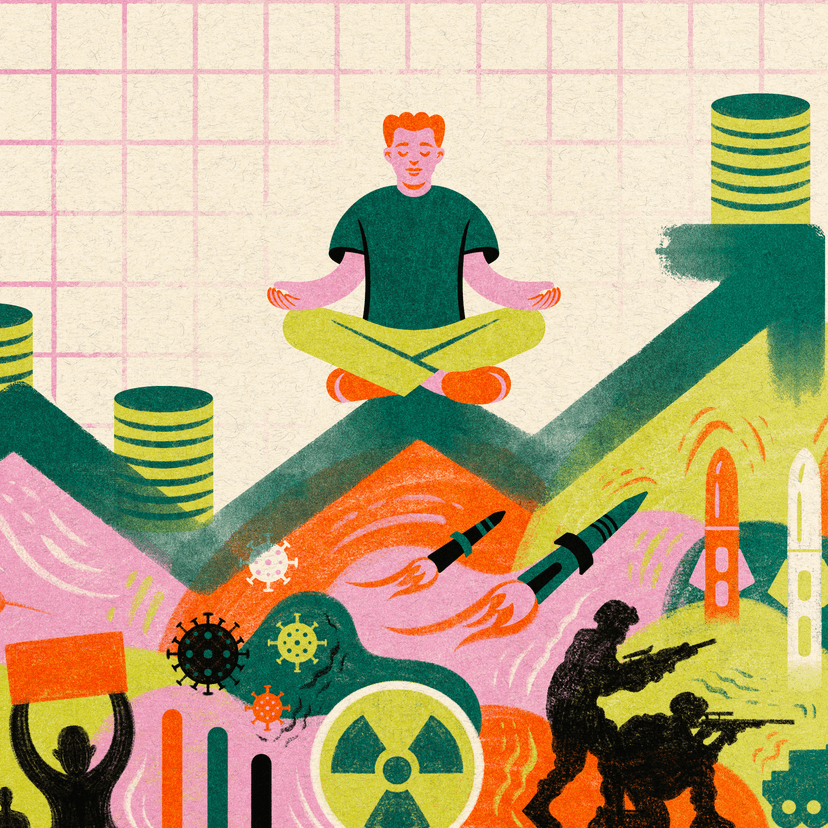
Global Markets Remain Resilient Despite Widespread Crises
Despite numerous global crises, stock markets have continued to prosper, leading economists to suggest a 'keep calm and carry on' approach for investors.
The Economist Announces 2026 Science and Technology Internship
The Economist is inviting applications for its prestigious 2026 Richard Casement internship in science and technology journalism.

PoliticsFox Newsbalkan-web6h ago2 sources Eliminimi i “El Mencho”-s, The Economist: Fitore për Trumpin, por faturë e lartë për Meksikën
Vrasja e Nemesio Rubén “El Mencho” Oseguera Cervantes, kreut të Kartelit të Gjeneratës së Re Jalisco, sipas një analize të publikuar nga The Economist, mund të shënojë një fitore simbolike për qeverin

Economist Discusses Russia's Economic Strain Amidst War
An economist discusses the increasing financial strain on ordinary people and the state in Russia, raising questions about potential social unrest or military rebellion due to lack of payments.

Economist Calls for Faster, More Ambitious Reforms in German Economy
An economist argues that Germany, the European Union's largest economy, needs to implement more ambitious and rapid structural reforms to overcome persistent problems and foster growth.

Hong Kong Considers Yuan Internationalization in Upcoming Budget
Economists suggest Hong Kong's upcoming annual budget should focus on strengthening the city's role in the internationalization of the Chinese yuan, aligning with Beijing's financial opening goals.

BRICS' Relevance and Challenge to Western Economic Dominance Questioned
Economist Jim O’Neill, who coined the term ‘BRIC’, argues that the BRICS group is losing its relevance and its ability to challenge Western economic dominance.

The Economist Names Woman as 'Most Powerful in the World'
The Economist has identified a woman as the 'most powerful in the world,' noting the long-standing dominance of Japan's Liberal Democratic Party (LDP) in the country's politics.

The Economist's Approach to Putin and Ukraine Cover Stories
Deputy editor Edward Carr discusses how The Economist develops its weekly cover stories focusing on Vladimir Putin, the war in Ukraine, and the concept of a modern 'Robin Hood state'.

People Loved the Dot-Com Boom. The A.I. Boom, Not So Much.
Tech leaders are beginning to worry about the public’s underwhelming enthusiasm for their plans to remake the world with artificial intelligence. Will that burst the bubble?
What the Supreme Court ruling against Trump tariffs means for your money
The Supreme Court ruled against a centerpiece of President Donald Trump's tariff agenda on Friday. Consumers could save money as a result, economists said.
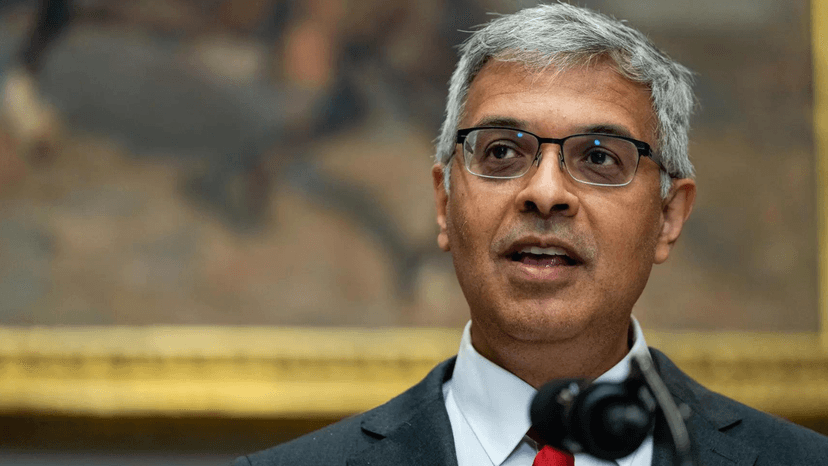
Indian-American Jay Bhattacharya to head CDC in addition to NIH
President Trump has appointed Indian-American Dr. Jay Bhattacharya to lead both the NIH and CDC, a first for federal health leadership. This consolidation aims to synchronize health policy, bridging research and implementation. Bhattacharya, a physician and health economist, previously co-authored the Great Barrington Declaration, advocating against universal Covid -19 lockdowns.

Hat-trick of good UK economic news, but US growth misses forecasts – business live
UK budget surplus hits record in January and retail sales rose, while private sector activity is strengthening in February
UK reports record-breaking budget surplus of £30.4bn in surprise boost for Rachel Reeves
Art and antiques help lift retail sales in Great Britain to biggest monthly rise since 2024
The jump in tax receipts last month may show that UK government receipts are starting to get the boost from inflation and wage growth earlier in the year.
Nick Ridpath, research economist at the Institute for Fiscal Studies, says:
Today’s data on the public finances is particularly important, given the outsized impact of January’s self-assessment returns on revenues and borrowing for the year as a whole.
Income tax receipts had been a little disappointing over 2025, lagging behind forecasts even as inflation and wage growth exceeded expectations. But today’s data shows that self-assessment revenues in January were almost £2bn (6%) higher than forecast.
Mail order retailers, which are predominantly online, experienced a boost from retailers selling sports supplements, as well as continued strong sales volumes by online jewellers. Comments from jewellers reported that demand had hit unprecedented levels.
Continue reading...

Fatih Birol: Turkish economist shaping global energy politics
From a 13-month contract at the International Energy Agency (IEA) in 1995 to leading the institution that world leaders now consult for guidance, Fatih Birol plays a dominant role...
Global Economy Projected to Grow 3.2% Driven by AI and Fiscal Policy
A Harvard economist predicts a sustained global economic growth rate of 3.2%, primarily fueled by investments in artificial intelligence and supportive fiscal policies.

PoliticswsjFTFox News+1billboard4d ago4 sources Rep. Jamie Raskin Respectfully Disagrees With Trump’s Springsteen ‘Loser’ Diss: ‘America Has No Kings, But We’ve Got One Boss’
The Maryland congressman, who has seen Bruce 13 times, snapped back at the president's disregard by suggesting he could "counter-program" by "singing a love song to Jeffrey Epstein."
Democrats Consider Price Controls to Combat High Grocery Costs
Democrats are exploring the controversial idea of capping grocery prices to address high food costs, a concept generally opposed by economists.

80% Plunge In Immigration Is Reshaping Labor Market Math, But AI Wildcard Looms: Goldman
80% Plunge In Immigration Is Reshaping Labor Market Math, But AI Wildcard Looms: Goldman
The Trump administration's crackdown on illegal immigration has resulted in an 80% collapse in net immigration to the USA, and has fundamentally altered the mathematics behind the nation's labor supply to the point where the level of job growth needed to maintain economic stability is now far lower, according to a new Goldman analysis.
After a flood of more than 10.8 million illegal immigrants (official figure) entered the United States under Biden, net immigration - both legal and illegal - has gone from roughly one million people per year in the 2010s to around 500,000 in 2025, with a further drop to just 200,000 projected by Goldman for 2026. This has sharply reduced labor-force growth and lowered the economy's "breakeven" pace of job creation, the bank opines.
Here's Goldman vs. Brookings vs. the Congressional Budget Office on net immigration:
Now, the US will only need around 50,000 new jobs per month by the end of this year to keep the unemployment rate from rising, down from roughly 70,000 today.
At the same time, Goldman says labor demand still looks "shaky" because job growth is narrow and job openings are trending lower - with the main downside risk being a faster, more disruptive AI-driven adjustment that could tamp down hiring or raise job losses beyond current estimates.
Elevated deportations, tighter visa / green-card policies, a pause in immigrant visa processing that affects dozens of countries, and the loss of Temporary Protected Status for some groups, Goldman suggests there is additional downside risk to the workforce.
A shakier demand picture
Of course, new math on the labor supply doesn't mean the labor market is strong (duh)... In fact, Goldman describes demand as “shaky,” writing that job growth has become increasingly narrow - dominated by healthcare - and that job openings have continued to fall. Openings are now around seven million, below pre-pandemic levels and still declining.
Because fewer new workers are entering the economy, hiring no longer needs to run as hot to prevent unemployment from drifting higher. “A small pickup is all that should be needed to sustain job growth at the breakeven pace,” according to the report, arguing that weaker-looking payroll numbers may increasingly mask a labor market that is merely treading water rather than deteriorating.
Official data from the Bureau of Labor Statistics show a similar trend, with job openings drifting toward the mid-six-million range late last year. A continued slide in openings, Goldman warns, would increase the risk that unemployment rises more meaningfully, even with slower labor-force growth.
There is also a risk that tighter immigration enforcement is pushing more workers into informal or off-the-books employment. If so, official payroll data could understate the true level of labor-market activity, complicating the Federal Reserve’s task of gauging economic momentum.
AI looms as the wildcard
Goldman sees artificial intelligence (AI) as the largest downside risk to the labor outlook - not because it has already triggered mass layoffs, but because it may restrain hiring at the margin. So far, the firm estimates that AI-related substitution has shaved only 5,000 to 10,000 jobs from monthly growth in the most exposed industries. But a faster or more disruptive deployment could weigh more heavily on demand.
...the main reason that we worry about downside risk to our baseline forecast that the labor market will stabilize going forward is the possibility of a faster and more disruptive deployment of artificial intelligence (AI). While plenty of recent anecdotes point to a potentially faster rate of adoption and corresponding job losses, it is hard to know how these will translate to macroeconomic outcomes. -Goldman
The bank shows that job growth has slowed and turned slightly negative in several subindustries where AI is most ready to deploy, while company-level anecdotes indicate that AI is already reducing the need for workers. The impact, while visible, remains 'moderate' so far.
For now, the bank expects the unemployment rate to drift only modestly higher, toward 4.5%, while Goldman chief economist Jan Hatzius said in a separate note (available to Pro subs) that the probability of a recession next year is "moderate" at 20%. The labor market, in the firm’s words, is taking “early steps toward stabilization.”
The paradox is that stability may increasingly look like weakness. As immigration slows and the workforce grows more slowly, payroll gains that once signaled trouble may soon be enough to keep the labor market steady - at least on paper.
h/t Capital.news
Tyler Durden
Wed, 02/18/2026 - 19:40

PoliticsBBCBusiness Insider5d ago2 sources Trump's top economic advisor says Fed researchers should be punished for their recent views on tariffs
Kevin Hassett, who is reportedly in the front-running to be the next Fed Chair, stands next to President Donald Trump in the Oval Office
Chip Somodevilla/Getty Images
Trump's top economic advisor sai

New York Fed Tariff Study Criticized by Former NEC Director
Former National Economic Council Director Kevin Hassett has strongly criticized a New York Fed tariff study, calling it the 'worst paper I've ever seen' and suggesting its authors should be disciplined for ignoring key aspects of how duties worked.

Nevada sues Kalshi as federal regulators say back off
Kalshi's website
Thomas Fuller/NurPhoto via Getty Images
Nevada regulators sued Kalshi, saying its markets are actually illegal sports gambling.
The suit was filed just as the Trump administration sided with prediction markets.
Other states have also sued Kalshi, and many legal observers expect the Supreme Court to weigh in.
Nevada gambling regulators sued the prediction markets company Kalshi on Tuesday, saying the platform's rapid growth forced their hand.
The Nevada Gaming Control Board and the state attorney general sued in Carson City District Court shortly after a federal appeals court rejected a request by Kalshi to stop the state from taking action. The state is seeking an order to stop Kalshi, the country's largest prediction market, from operating what it sees as an unlicensed sports betting operation.
"Kalshi has continued to dramatically expand its business, rather than attempting to maintain any kind of status quo," Nevada authorities said in a letter earlier this month.
The regulators emphasized that Kalshi has grown rapidly, doing 27 times as much business on Super Bowl Sunday this year compared to the year before. Meanwhile, regulated Nevada gambling operations saw their business shrink, the state said.
A Kalshi spokesperson declined to comment on Tuesday afternoon, but the company swiftly asked a federal court to take over the new state case. They argued that only federal law applies to prediction markets, and that the new state enforcement action turns on the same questions that federal courts are already considering.
Kalshi has said that its markets are "event contracts," a financial instrument regulated by the Commodities Futures Trading Commission. The CFTC on Tuesday sided with another events-contracts company that is fighting with Nevada regulators, and its chairman, Michael Selig, filmed a video statement defending the new platforms.
"Today, the CFTC is taking an important step to ensure that these markets have a place here in America," Selig said. "To those who seek to challenge our authority in this space, let me be clear: we will see you in court."
Economists and political scientists have long been fascinated by prediction markets as a way to channel the so-called wisdom of the crowds. They were generally a niche activity until the 2024 US presidential election, when people wagered millions of dollars on sites like Polymarket.
Since the election, sports and cryptocurrency speculation have become the dominant markets. Today, more than 90% of the money that flows through Kalshi's platform is staked on sports-related events, and the growth of platforms like Kalshi has spurred traditional sportsbooks like FanDuel and DraftKings to create their prediction markets to take advantage of the light-touch regulation and lower taxes they offer.
Legal battles are pending on the East Coast as well, with regulators in Maryland and New Jersey having clashed with prediction markets. Attorneys and other industry commentators have said they expect the Supreme Court to eventually weigh in on the legality of sports contracts on prediction markets.
Read the original article on Business Insider

The shutdown of USAID and the deeper crisis behind it
“Why did you start driving inDrive?”
It’s my go-to icebreaker with drivers in Pakistan. Lately, the answers have been unsettlingly similar. “I used to work in the development sector,” one man told me. “Then I lost my job.”
I’ve heard that line — or a version of it — too many times to dismiss as coincidence.
Since the United States pulled the plug on its aid apparatus, the fallout has been immediate. On the surface, the shutdown of USAID is being framed as just another abrupt policy reversal — a bureaucratic casualty in an era of disruption. But look closer, and it reveals something far more profound: the cumulative weight of domestic and international tensions that have been simmering, both within and beyond the US for decades.
Cycles of aid, cycles of distrust
The first source of strain lies beyond US borders. From its inception as a Cold War instrument, American foreign aid has been shaped by an enduring tension between its declared objectives of development and altruism and its underlying strategic and political calculations.
This duality has long been apparent to the recipient elites and the broader public alike. During the Cold War, many governments acquiesced, in part because Western donors faced little competition and alternative sources of assistance were scarce. That landscape has since changed. As non-traditional donors, most notably China and the Gulf states, have expanded their presence, and as domestic political incentives within recipient countries have shifted, scepticism toward USAID has become more explicit and politically salient.
In countries such as Pakistan, where mistrust of American intentions runs deep, US assistance is often perceived less as generosity than as intrusion. What is now framed as a backlash against American aid is better understood as the culmination of a long-simmering tension and a legacy of mutual misperceptions between donor and recipient.
Pakistan’s experience with US foreign aid agency illustrates this dynamic with particular clarity. American assistance to Pakistan has never been linear or predictable; instead, it has unfolded in cycles closely attuned to Washington’s shifting strategic priorities. During the Cold War, aid was channelled primarily through a security-alliance framework aimed at containing the Soviet bloc, with economic assistance tightly coupled to military cooperation. These flows declined sharply after the 1965 war, reinforcing perceptions of US aid as conditional, transactional, and reversible.
Another peak in this equation followed in the 1980s, when General Ziaul Haq aligned Pakistan with the US in opposing Soviet expansion in Afghanistan. Yet with the collapse of the Soviet Union, and the subsequent imposition of US sanctions on Pakistan’s nuclear programme under the Pressler Amendment, assistance once again contracted. It was only after 9/11 that the aid surged anew, this time framed around counterterrorism and stabilisation. Even at its height, however, much of this assistance remained shaped by security imperatives, short funding horizons, and heavy reliance on contractors, rather than long-term institution-building.
For many Pakistanis, therefore, the shutdown of USAID feels less like an abrupt rupture than the latest turn in a familiar cycle of engagement and disengagement.
The second factor is bureaucratic pathologisation. Like many large organisations, aid agencies are susceptible to institutional dysfunction, and USAID has been no exception. In practice, particularly in contexts such as Pakistan, as commissioner on the Afghanistan War Commission Andrew Wilder has noted, its programmes increasingly came to be structured through a security lens rather than a development one. Key decisions were made in Washington, filtered through multiple layers of contractors, and ultimately deployed on the ground with limited scope for local input.
At the same time, bureaucratic incentives privileged projects with easily quantifiable indicators, favouring what could be measured over what was substantively effective. These patterns were neither accidental nor new, nor are they unique to the US. Over time, however, they eroded both the legitimacy and the perceived effectiveness of USAID, among recipients abroad and critics at home.
These institutional dynamics had tangible consequences on the ground. In Pakistan, USAID funding became heavily concentrated in sectors aligned with stabilisation and security objectives — such as service delivery in so-called “fragile” districts or rapid-impact infrastructure — often at the expense of slower, politically unglamorous investments in local institutional capacity. NGOs and development professionals structured entire career paths around USAID project cycles, only to see those opportunities vanish when priorities shifted or funding was abruptly frozen.
The result was a hollowing out of local expertise and institutional memory. When aid was withdrawn, it left behind far fewer durable institutions than its scale and visibility might have led one to expect.
The mismatch between stated development objectives and the underlying security logic was further compounded by an overreliance on quantifiable metrics to demonstrate impact. This tendency was reinforced by a development ecosystem shaped by the overproduction of economists and political scientists trained as methodological specialists rather than regional experts. Programmes designed in Washington often prioritised what could be easily counted — number of schools built, clinics refurbished, trainings delivered, or kilometres of roads completed — over whether such interventions meaningfully strengthened local institutions.
In Pakistan, this logic was especially evident in sectors such as education, health, and local governance, where projects were assessed primarily through output indicators rather than sustainability or local ownership. Multiple layers of contractors further diluted accountability and blurred responsibility once funding cycles ended. Over time, this produced a paradox: USAID became both omnipresent and poorly understood — associated with large budgets and extensive reporting, but yielding limited and uneven institutional impact. That credibility gap left the agency especially exposed when domestic political support in the US began to erode.
The third major factor behind the dismantling of the aid lies in the domestic backlash within the US against international cooperation. Opposition to foreign aid, multilateralism, and international institutions long predates Donald Trump, reflecting decades of polarisation over globalisation and America’s role in the world. By the time Trump entered office, hostility toward international engagement was already deeply embedded in US politics.
In this context, shuttering a highly visible aid agency became a potent domestic signal; it becomes a way to demonstrate responsiveness to voters who view global commitments as costly, wasteful, or illegitimate. Dismantling USAID was therefore less a recalibration of foreign policy than an act of domestic political theatre.
The US government’s official justification for shutting down USAID frames the move as a response to “China’s exploitative aid model” and a means of advancing American “strategic interests in key regions around the world”.
It is true that China has dramatically expanded its development footprint and largely operates outside the traditional Western aid framework. But that explanation doesn’t hold up to deeper scrutiny. If Washington were genuinely seeking to compete with Beijing in the development arena, the more coherent response would have been reform and reinvestment, not withdrawal.
Moreover, Chinese and US aid are not direct substitutes. They target different sectors, rely on distinct instruments, and frequently operate alongside one another in the same countries — Pakistan among them — without displacing each other.
In Pakistan, Chinese assistance has concentrated on large-scale infrastructure and energy projects, while USAID has focused primarily on education and health. Chinese aid typically flows through bilateral, government-to-government channels, whereas US assistance has often bypassed the Pakistani state, working instead through NGOs and contractors. China’s rise may well be sharpening anxieties in Washington, but it does not, on its own, explain why the US would choose to erode its own institutional capacity in response.
A looming domino effect
The shutdown of USAID, then, should not be understood as a one-off policy blunder or an idiosyncratic choice tied to a single administration. Rather, it reflects the convergence of long-accumulating tensions: between the professed ideals and strategic deployment of aid abroad; between development objectives and bureaucratic practices within aid agencies; between international commitments and domestic political incentives at home.
USAID’s collapse is best understood not as the cause of these pressures, but as their most visible manifestation.
The consequences of this decision extend well beyond the fate of a single agency. They reveal the fragility of the broader international aid regime, which ultimately depends on the willingness of a small number of leading powers to absorb the political and financial costs of institutionalised cooperation.
When that willingness erodes, institutions lose both credibility and purpose and eventually collapse. Signs of this erosion are already evident, as other major donors, including the United Kingdom and Germany, begin to scale back their own aid commitments.
What is at stake, then, is not merely the dismantling of USAID, but the gradual unravelling of an international aid regime built on mutual trust and a sustained commitment to lifting the world’s poorest out of poverty.

FinanceNYTwsjThe Guardian8d ago3 sources US Inflation Eases in January Amid Ongoing Tariff Debate
US inflation fell to 2.4% in January, with economists predicting further easing, while research confirms that consumers are bearing the costs of tariffs despite previous claims.
Economist Warns of Worst Fears for US Economy Amidst K-Shaped Recovery
The economist who initially identified America's K-shaped recovery expresses his gravest concerns for the future of the US economy.

ECB Economists Highlight Regulatory Risks in European Asset Management
Economists at the European Central Bank are questioning the dominance of Ireland and Luxembourg in asset management, warning that fragmented national regulation could create supervisory blind spots.