Putin Prioritizes Modernization of Russia's Nuclear Arsenal
Russian President Vladimir Putin has declared the development and modernization of the country's nuclear weapons arsenal an "absolute priority," following the New START agreement.
10 stories found
Russian President Vladimir Putin has declared the development and modernization of the country's nuclear weapons arsenal an "absolute priority," following the New START agreement.
The Cats have a schedule change that will allow the crucial Vanderbilt clash to air on TV.

A top official has stated that there is no 'gentlemen's agreement' with Russia to continue compliance with the New Start Treaty, as reported by The Libertarian Institute.
The New START treaty, while not a complete solution, played a vital role in preventing a new nuclear arms race and maintaining global safety.
The DIAA boys and girls basketball tournaments have been postponed due to inclement weather, with new start dates scheduled for Wednesday, February 25th, and Thursday, February 26th, respectively.
The Trump administration has allowed the New START nuclear treaty to expire, with one opinion piece arguing that the treaty was ineffective in protecting American interests.

Kremlin Mocks European 'Illusions' For Wanting Own Nuclear Umbrella Currently France and Britain are in talks to potentially extend their nuclear arsenals to protect Europe as a defense 'umbrella' - at a moment some officials have questioned the United States commitment to leading NATO. Politico wrote in the aftermath of the Munich Security Conference, "Multiple European countries are publicly backing talks on a homegrown nuclear deterrent to complement American atomic weapons following an erosion of trust in a Donald Trump-led US." Russian Ambassador to the UK Andrey Kelin has issued the Kremlin's reaction to these latest developments, asserting that the British ‘nuclear umbrella’ will fail to provide extra security to other NATO members. Russian Ambassador to the UK Andrey Kelin, via Al Jazeera screenshot. The diplomat's words were captured in an interview with Russian newspaper Izvestia on Tuesday. Kelin described that it is "obvious that the British 'nuclear umbrella' will not be able to provide any additional material security guarantees" to Europe. Moscow meanwhile continues to closely monitor the moves by "states pursuing an overtly anti-Russian policy" - he emphasized. "The possibility of the expansion of nuclear safeguards will be taken into account in our military planning as well as in further discussions of the strategic stability issues," the ambassador added. Kelin then took a swipe at Britain's hawkish stance in the context of the Ukraine war: "The strengthening of such potential apparently instills in London an illusory hope of leadership in ensuring European security," he said. Moscow's growing concerns over British policy is in part related to plans to purchase a dozen F-35 fighter jets from the US, capable of carrying missiles tipped with nuclear warheads. Additionally, when the tiny but outspoken Baltic states - directly on Russia's doorstep - try to tout NATO 'nuclear deterrent' talking points, it seems natural that Moscow would be extremely concerned: Estonia isn’t ruling out joining early-stage talks on a common nuclear deterrent in Europe, Deputy Defense Minister Tuuli Duneton said in an interview. "We are always open to discuss" with partners, she said, while emphasizing the U.S. was still "committed to providing nuclear deterrence for allied nations." Latvia’s Prime Minister Evika Siliņa echoed that. "Nuclear deterrence can give us new opportunities. Why not?" she said, while cautioning that any steps would have to be in compliance with "our international commitments." NATO top leadership has still signaled no change in direction on the conventional US nuclear umbrella, however. The United States nuclear umbrella, which has protected allies and cut down on the spread of nuclear weapons, is the "ultimate guarantor of freedom" in Europe, NATO Secretary-General Mark Rutte says. "The ultimate guarantor is the nuclear umbrella from the United States," Rutte… pic.twitter.com/8GCU5oc4O6 February 17, 2026 In the backdrop is the fact that that the landmark New START nuclear treaty between Washington and Moscow has ceased to exist as of this month. Russia is offering that it won't expand its arsenal so long as the US does the same. But this is still dangerous, uncharted territory. Tyler Durden Wed, 02/18/2026 - 04:15
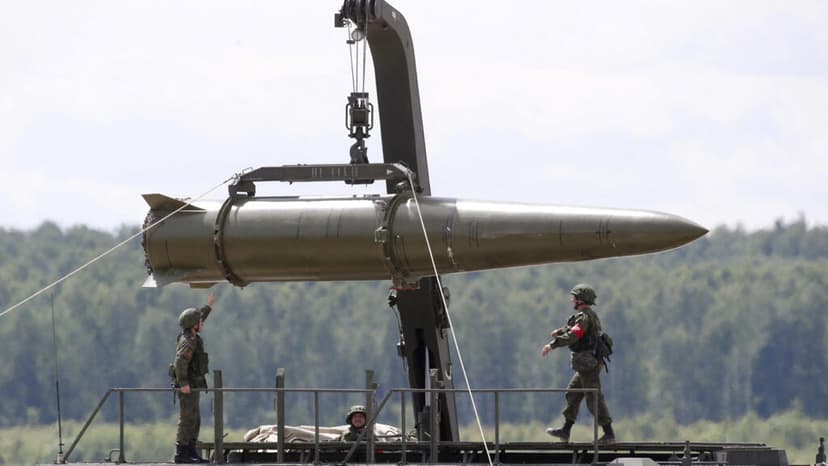
The expiration of the New START treaty, which for 15 years limited US and Russian nuclear arsenals, has sparked concerns about the future of nuclear disarmament efforts.

Beijing Blasts Trump After US Releases New Details On Alleged 2020 Chinese Nuclear Test Update: Despite the Lunar New Year holiday, Beijing has made it known it is not best pleased with Washington digging up Nuke blasts from the past. Issuing a statement via state mouthpiece (@HuXijin_GT), the CCP suggested an ulterior motive for the timing of this announcement: "Trump is eager to resume nuclear testing and needs a plausible reason, and accusing China of conducting nuclear tests is the perfect pretext. Assistant Secretary of State Christopher Yeaw stated on Tuesday that the US is prepared to conduct low-yield nuclear tests in response to alleged secret nuclear tests by China and Russia. The US is being far too hasty; having just fabricated rumors that China conducted an explosive nuclear test nearly six years ago, they are already announcing their own low-yield nuclear test. Washington's motives for spreading these rumors are too clear; they can't even be bothered to feign it." Hard to disagree with the latter point. * * * As Kimberley Hayek detailed earlier via The Epoch Times, a senior State Department official released additional evidence Tuesday in support of U.S. allegations that China conducted an underground nuclear test in June 2020, as global arms control frameworks unravel. Assistant Secretary of State Christopher Yeaw, while speaking to a Hudson Institute meeting, discussed data from a remote seismic station in Kazakhstan that recorded a magnitude 2.75 “explosion” approximately 450 miles from China’s Lop Nur test grounds on June 22, 2020. “I’ve looked at additional data since then. There is very little possibility I would say that it is anything but an explosion, a singular explosion,” Yeaw said, underscoring that the data were not consistent with blasts from mining. “It’s also entirely not consistent with an earthquake,” said Yeaw, a former intelligence analyst and defense official who holds a doctorate in nuclear engineering. “It is ... what you would expect with a nuclear explosive test.” Yeaw argued that China tried to hide the event through decoupling, detonating the device in a spacious underground cavity to diminish seismic waves. Under Secretary of State for Arms Control Thomas DiNanno earlier this month accused China of performing such secretive nuclear arms tests and implementing measures to restrict seismic evidence. “Today, I can reveal that the U.S. Government is aware that China has conducted nuclear explosive tests, including preparing for tests with designated yields in the hundreds of tons,” DiNanno said. These claims back up Yeaw’s assertions of concealment tactics. The Comprehensive Nuclear-Test-Ban Treaty Organization, which monitors global explosions, noted that available data do not allow for firm conclusions. Executive Secretary Robert Floyd said in a statement that the seismic monitoring station in Kazakhstan captured “two very small seismic events” 12 seconds apart on June 22, 2020. The organization’s network detects events equivalent to 551 tons (500 metric tons) of TNT or more, according to Floyd. “These two events were far below that level,” Floyd said. “As a result, with this data alone, it is not possible to assess the cause of these events with confidence.” China, a signatory to the 1996 Comprehensive Nuclear-Test-Ban Treaty but not a ratifier, rejected the initial U.S. accusation at an international conference this month. Beijing’s last acknowledged underground test occurred in 1996. The United States, which also signed but did not ratify the treaty, is legally bound to its terms under international norms. America’s final underground test was in 1992, with subsequent reliance on sophisticated simulations and supercomputers for warhead maintenance. President Donald Trump recently called on China to take part in trilateral talks with Russia to support the New Strategic Arms Reduction Treaty (New START), which ended Feb. 5. China refused the invitation, arguing that its arsenal is far smaller than those of the United States and Russia. The Pentagon estimates China’s current operational warheads at more than 600. The stockpile is expected to exceed 1,000 by 2030. The Federation of American Scientists, an organization working to minimize the risks of nuclear threats, tracks Russia as currently having 5,459 warheads, while the United States has 5,177. The New START accord expiration removes caps on deployed strategic warheads and delivery vehicles, potentially accelerating buildups. Russia and the United States said they would informally observe limits. Tyler Durden Thu, 02/19/2026 - 04:15
A program in turmoil gets a new start today. What will they make of it?