
Three Arrested for Illegal Excavation at Archaeological Site in Thessaloniki
Three individuals were arrested in Thessaloniki for illegally excavating within an archaeological site, violating laws protecting antiquities and cultural heritage.
37 stories found
Three individuals were arrested in Thessaloniki for illegally excavating within an archaeological site, violating laws protecting antiquities and cultural heritage.
Urban Soul Project, awarded 'Architectural Office of the Year' at the GRAIL awards, is recognized for its unique and impressive 'transparent' house in Thessaloniki.

The province of Tarragona, known as Costa Daurada, will host a major stage of the Volta a Catalunya and the Mussara Salou Costa Daurada cycling tour, establishing itself as a cycling hub.

A fire broke out in an abandoned building within the former Kodra camp in Kalamaria, Thessaloniki, on Sunday night. Firefighting efforts are underway, and the situation is reportedly improving.

«Un couteau aurait été exhibé par l’un des protagonistes sans qu’il en fasse usage», selon une source policière. Un policier et un gendarme ont été légèrement blessés.

A major brawl erupted during an NBA game between the Miami Heat and Memphis Grizzlies, prompting intervention from coaches.

The 22nd round of the Super League features critical matches for AEK, PAOK, and Panathinaikos in the title race, alongside intense survival battles in Serres and Thessaloniki, with teams facing European commitments, suspensions, and absences.

Police in Bucharest conducted raids on two erotic massage salons, arresting administrators and employees, including the widow of Gabriel Cotabiță, on charges of pimping.

A 30-year-old man was arrested in Thessaloniki for harassing passengers during a flight from a European city to Macedonia Airport.

With Grizzlies in tank mode, Tuomas Iisalo was left to …

Director Tobias Nölle discusses the challenges and freedoms of filming his Berlinale film 'Tristan Forever' on Tristan da Cunha, one of the world's most remote inhabited islands.

The Commission on Audit (COA) has affirmed that former Nueva Ecija town mayor Arvin Salonga is liable for negligence in a municipal hall fire, citing a lack of safety measures.

A review assesses the effectiveness of Shark’s new FacialPro Glow + DePuffi gadget, which promises to address various skin concerns from pore size to puffiness, questioning if an at-home hydrofacial device can truly replace professional salon treatments.
Poland's president has approved a law, dubbed 'Lex Huawei,' which will allow the government to exclude risky telecommunications equipment manufacturers. Thousands of businesses will need to prepare for its implementation in about a month.
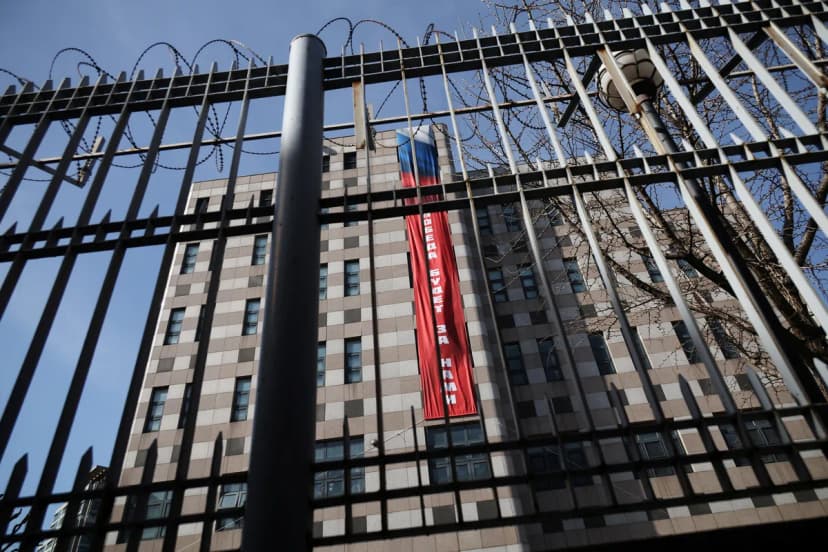
Južna Koreja zatražila je od ruske ambasade u Seulu da ukloni veliki transparent na kojem je pisalo "Pobeda će biti naša", saopštilo je Ministarstvo

The Mexican army killed Nemesio Rubén Oseguera Cervantes, known as 'El Mencho', leader of the Jalisco New Generation cartel, during a military operation.

A fire erupted in an abandoned building at the former Kodra military camp in Kalamaria, Thessaloniki, with firefighting operations currently underway.
Thousands of participants in the upcoming Vasaloppet ski race are facing potential slushy conditions as milder temperatures are forecast for the end of the week.

Laundry rooms are moving from basements to communal living spaces, with Vienna leading this trend.

Traffic police in Thessaloniki, Greece, issued a violation to a taxi driver who was found using a mobile application to calculate fares instead of the legally required taximeter, causing customer complaints.

Nine individuals, including managers and employees of two erotic massage salons in Bucharest, have been detained and are under investigation for facilitating prostitution, with one of the arrested being the widow of a famous artist.

Two elderly residents died in a house fire in Salo, Finland. Rescue services found both individuals deceased inside the burning home.
A teenager has been arrested in Thessaloniki in connection with an alleged assault and the distribution of revenge porn.

The 28th Thessaloniki International Documentary Festival has announced the lineup for its International Competition section, scheduled to run from March 5-15.
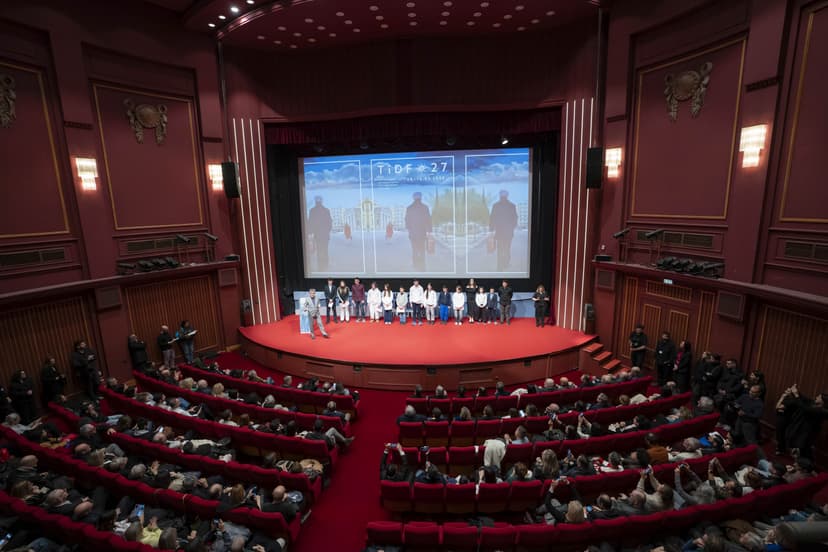
The 28th Thessaloniki International Documentary Festival in Greece has unveiled the films selected to compete in two of its main competitive categories.
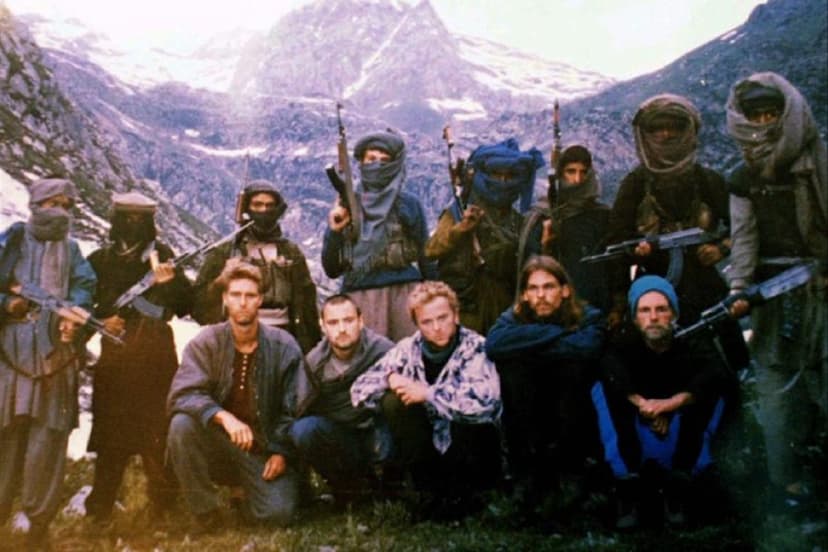
“Golden Swan,” which has its world premiere in the International Competition section of the 28th Thessaloniki Intl. Documentary Festival, has debuted its trailer. The film, directed by Anette Ostrø, looks back to 1995, when her brother, Hans Christian Ostrø, travelled to India in search of meaning and artistic growth. Months later, he is kidnapped in […]

A fire that broke out yesterday in an abandoned building within the former Kodra camp in Kalamaria, Thessaloniki, has been brought under partial control.
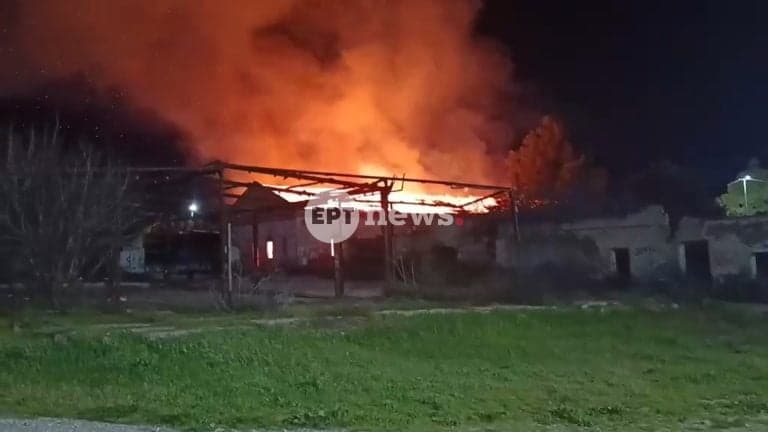
A fire broke out in an abandoned building within the former Kodra military camp in Kalamaria, Thessaloniki. Firefighting efforts are underway, and the situation is reportedly improving.
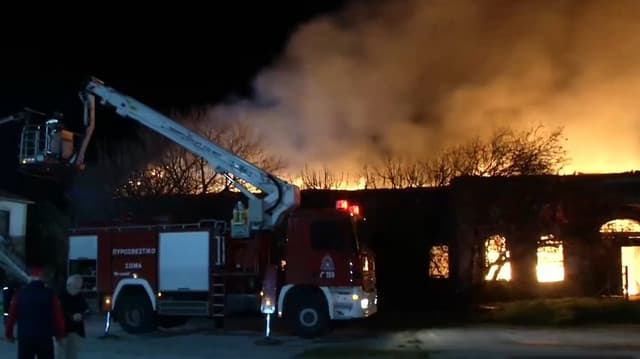
A fire erupted in an abandoned building at the former Kodra camp in Kalamaria, Thessaloniki. Twenty firefighters are on site to extinguish the blaze.

Multiple bomb threats in Paris led to the evacuation of the Institute of Political Studies and the Montparnasse Tower, with police conducting thorough searches.

Three young individuals were arrested in Thessaloniki, Greece, after a driver refused to stop for a police check, sped away, and crashed into a parked vehicle.

A 30-year-old man was arrested after causing a disturbance and attacking a police officer on a flight bound for Thessaloniki's Macedonia Airport.

A taxi driver in Thessaloniki was fined by traffic police for using a mobile application to calculate fares instead of the legally required taximeter.
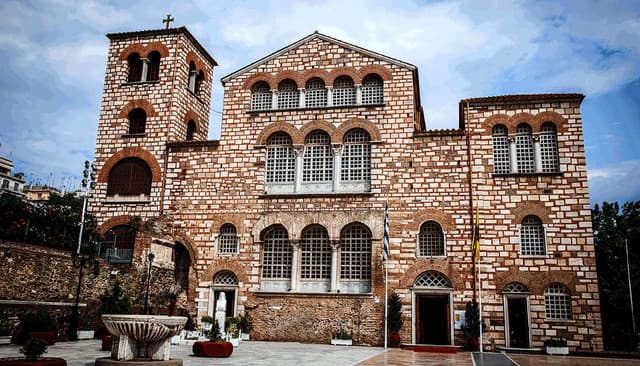
A memorial service for the victims of Russia's invasion of Ukraine was held in Thessaloniki, organized by the Ukrainian Consulate and the 'Ukrainian-Greek Initiative' association.
The ceremony, set to take place in Hollywood March 2, will also see trophies presented to Autumn Durald Arkapaw, IMAX's Patricia Keighley, Salomon Ligthelm and the TV series 'Fallout.'
Memphis Grizzlies coach Tuomas Iisalo offered updates on the injury status of key players Ja Morant, Zach Edey, and Cedric Coward, who have all missed recent games.

Voyages To The End Of The World: The Moral Costs Of Techno-Utopianism In their highly read First Things essay “Voyages to the End of the World,” Peter Thiel and Sam Wolfe use Francis Bacon’s utopian “New Atlantis” to argue that modern faith in unlimited technological progress has subtly redefined salvation as a human-controlled achievement rather than a divine gift, displacing religious understandings of human destiny with promises of security, abundance, and mastery over nature. They warn that this Baconian project - disguised in Christian imagery - risks creating a seductive but spiritually impoverished civilization where technological power outpaces moral wisdom, potentially leading to an end-times trajectory of false salvation unless reintegrated into a framework that respects natural and spiritual limits. Authored by William Brooks via The Epoch Times, Founded in 1990 by the late Fr. Richard John Neuhaus, First Things magazine strives to promote a well-informed public philosophy in the Christian and Jewish traditions. Last year, one of the most read essays in First Things was titled: “Voyages to the End of the World” by Peter Thiel and Sam Wolfe. Thiel is a tech entrepreneur, investor, and author. Wolfe is a writer and researcher at Thiel Capital. These thinkers offer a probing examination of our modern technological ambitions. Using Francis Bacon’s unfinished 17th-century work “New Atlantis” as a point of departure, Thiel and Wolfe suggest that modern faith in scientific progress is corroding the religious understanding of human destiny. They contend that Bacon’s utopian tale about knowledge and prosperity contains a warning about the moral costs of unlimited technological mastery. Thiel and Wolfe’s central claim is not that science itself is evil or that technological progress must be rejected. Rather, they argue that Bacon’s scientific project—and the modern world that has adopted it—rests on a redefinition of salvation. Whereas Christianity views redemption as a divine process that transcends history, Bacon relocates it firmly within human control. In doing so, modern technological civilization risks mistaking power for wisdom. This could have grave consequences as we enter an epoch defined by unprecedented technological advancement. At the heart of their essay is a close look at Bacon’s fictional account of the island society of Bensalem. On its surface, Bensalem appears harmonious, pious, and benevolent. Its inhabitants are devout, orderly, and humane; its institutions promise healing, abundance, and stability. Its governing institution, Salomon’s House, is dedicated to the systematic investigation of nature for the “relief of man’s estate.” Bacon presents scientific inquiry as a quasi-religious vocation, cloaked in Christian imagery and moral restraint. Thiel and Wolfe warn that this superficial harmony conceals a radical transformation of the human relationship to nature, knowledge, and God. They argue that Bacon’s true ambition was not merely to advance science but to replace the classical-Christian understanding of limits with a project of total technological mastery. Knowledge, in Bacon’s vision, is not ordered toward moral formation but toward domination and control. Nature is no longer something to be understood within an inherited moral order; it is something that can be conquered and redesigned. This shift has profound implications. Bacon’s scientific method implicitly promises what religion once offered: security, healing, abundance, and even a form of immortality. By embedding these promises within a framework that appears Christian, Bacon disguised the degree to which his vision subtly marginalized the hand of God. In New Atlantis, God remains present, but increasingly as a symbolic guarantor of human progress rather than as the ultimate judge of human action. Thiel and Wolfe interpret this displacement through an eschatological lens. Drawing on biblical imagery, they suggest that Bacon’s utopia resembles the deceptive peace promised in apocalyptic literature—a peace achieved not through repentance or divine reconciliation, but through human ingenuity and centralised power. The danger is not tyranny in its crudest form, but something more seductive: a world so efficient and secure that it no longer recognizes its spiritual impoverishment. One of the essay’s most troubling conclusions is that modern technological civilization may be better understood as an end-times trajectory rather than a benign accumulation of new tools. Scientific progress does not merely extend human capacities; it reshapes human expectations about the future. When technology promises to eliminate scarcity, suffering, and even death, it inevitably assumes the role once played by theology. In this sense, modernity reconfigures the religious impulse by substituting technique for grace. The authors argue that this substitution is inherently unstable. Technological power expands far more rapidly than moral wisdom, and the belief that every problem has a technical solution blinds societies to questions of meaning, responsibility, and restraint. The more humanity relies on systems it only partially understands—artificial intelligence, biotechnology, etc.—the more it risks becoming subject to forces it can neither fully control nor morally justify. A further conclusion concerns the cultural conditions that allow this dynamic to persist. Thiel and Wolfe suggest that widespread biblical and philosophical illiteracy leaves contemporary society unable to recognize the spiritual dimensions of technological ambition. Apocalyptic language, once central to the Western moral imagination, is now dismissed as superstition. Yet without such language, we lose a critical framework for discerning the difference between genuine progress and false salvation. The result is not rational clarity, but naivete—a readiness to accept sweeping promises of safety and efficiency without asking what is being sacrificed in return. The relevance of “Voyages to the End of the World” becomes especially clear as we move deeper into the 21st century. Humanity now possesses technologies capable of reshaping life itself, from genetic engineering to autonomous systems that make decisions once reserved for human judgment. Political and economic leaders increasingly speak in utopian terms, promising that innovation will solve social conflict, environmental degradation, and even moral disagreement. These assurances echo Bacon’s vision of a world governed by knowledge rather than virtue, technique rather than tradition. Thiel and Wolfe suggest we correct our course. They invite readers to reconsider whether the goals of technological civilization are as harmless as they appear. The question is no longer whether we can build more powerful tools, but whether those tools are shaping a conception of life that is ultimately compatible with human well-being. The authors do not advocate withdrawal from modern life or a rejection of scientific inquiry. Their argument is one of discernment. Technological progress, they assert, must be reintegrated into a moral framework that acknowledges the natural limits of human power. Without such a framework, progress becomes self-justifying, and power becomes an end in itself. We are reminded that the future we build should not be merely technical. It should also be moral, spiritual, and ultimately related to the destiny of human souls. As the second quarter of the 21st century unfolds, “Voyages to the End of the World” offers a timely caution. The greatest danger facing technological civilization may not be catastrophe, but success—the achievement of a techno-managed world that no longer knows why or for what it exists. Views expressed in this article are opinions of the author and do not necessarily reflect the views of The Epoch Times or ZeroHedge. Tyler Durden Mon, 02/16/2026 - 23:35