Dawn1h ago
Bibi Houri is no more, but her quest continues
QUETTA: “There is no news of my son, whether [he is] alive or dead. I have been on the roads for 14 years… I have grown old, and people have to hold my hand while disembarking from a vehicle. But I protest here so that I get justice.”
These are the words of the late Bibi Houri, immortalised in a brief clip that has been circulating on social media since her demise.
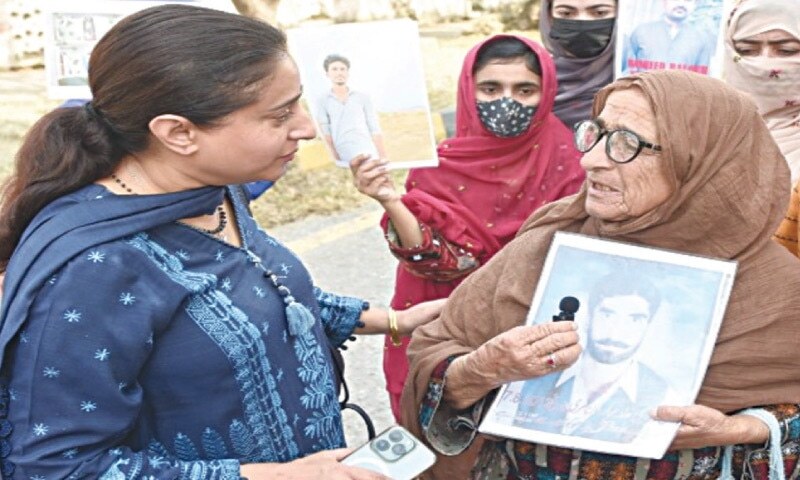
Since 2012, when her son went missing in Balochistan, Bibi Houri had been a regular fixture at demonstrations staged by relatives of missing persons. Despite her advanced years, she would sit from dawn to dusk at the protest camps, pining for her son Gul Mohammad Marri and hoping for his safe recovery.
The widow, in her 70s, who broke with societal norms by coming out of her home and seeking justice — on the roads, in court, and at police stations — breathed her last on Tuesday.
Septuagenarian had been campaigning for her missing son’s recovery since 2012
“She used to come to the missing persons’ camp along with her missing son’s daughter — even on Eid,” recalled Nasrullah Baloch, chairman of Voice for Baloch Missing Persons (VBMP).
Bibi Houri — also known affectionately as ‘Amma Houri’ — hailed from Kohlu, a district dominated by the Marri tribe in eastern Balochistan.
After the end of the fourth Baloch insurgency, which was fought predominantly by Marri Baloch tribesmen, her family went to Afghanistan along with the other Marri tribesmen.
Upon their return, they settled in New Kahan, on the outskirts of Quetta, near the Hazarganji area.
“After his cousin, Dr Mohammad Akbar Marri, went missing in 2010, Gul Mohammad started struggling for his safe release because (Dr Marri’s) children were too young to come out,” recalls Nasrullah Baloch.
“Instead, he himself became a missing person within two years.”
An activist who used to participate in demonstrations alongside the septuagenarian told Dawn that Bibi Houri came into the media limelight in 2023, when several Baloch families staged a long march to Islamabad.
At the time, the families of the missing — comprising mostly women and children — were dealt with unsympathetically, being subjected to baton-charges and water cannons after they reached the capital.
Besides Islamabad, the elderly Bibi Houri attended public meetings and protests in Mastung, Quetta, and Dalbandin, among other places. She would stand among the crowd, holding her son’s photo while calling for the recovery of all missing persons.
“There are many women like Bibi Houri who search for their sons, brothers or husbands & sometimes die without ever knowing whether they are alive or dead,” journalist Munizae Jahangir wrote on X.
“Houri worried for her son Marri’s children who are growing up without a father, she said she was old but she braved the rain & the unforgiving sun for them,” she wrote in her epitaph.
Former human rights minister Shireen Mazari also lamented on X that there was no one to pursue Bibi Houri’s legal case following the imprisonment of her daughter, Imaan Mazari-Hazir, who had been handling it.
Published in Dawn, February 19th, 2026
By none@none.com (Muhammad Akbar Notezai)
Read full article →