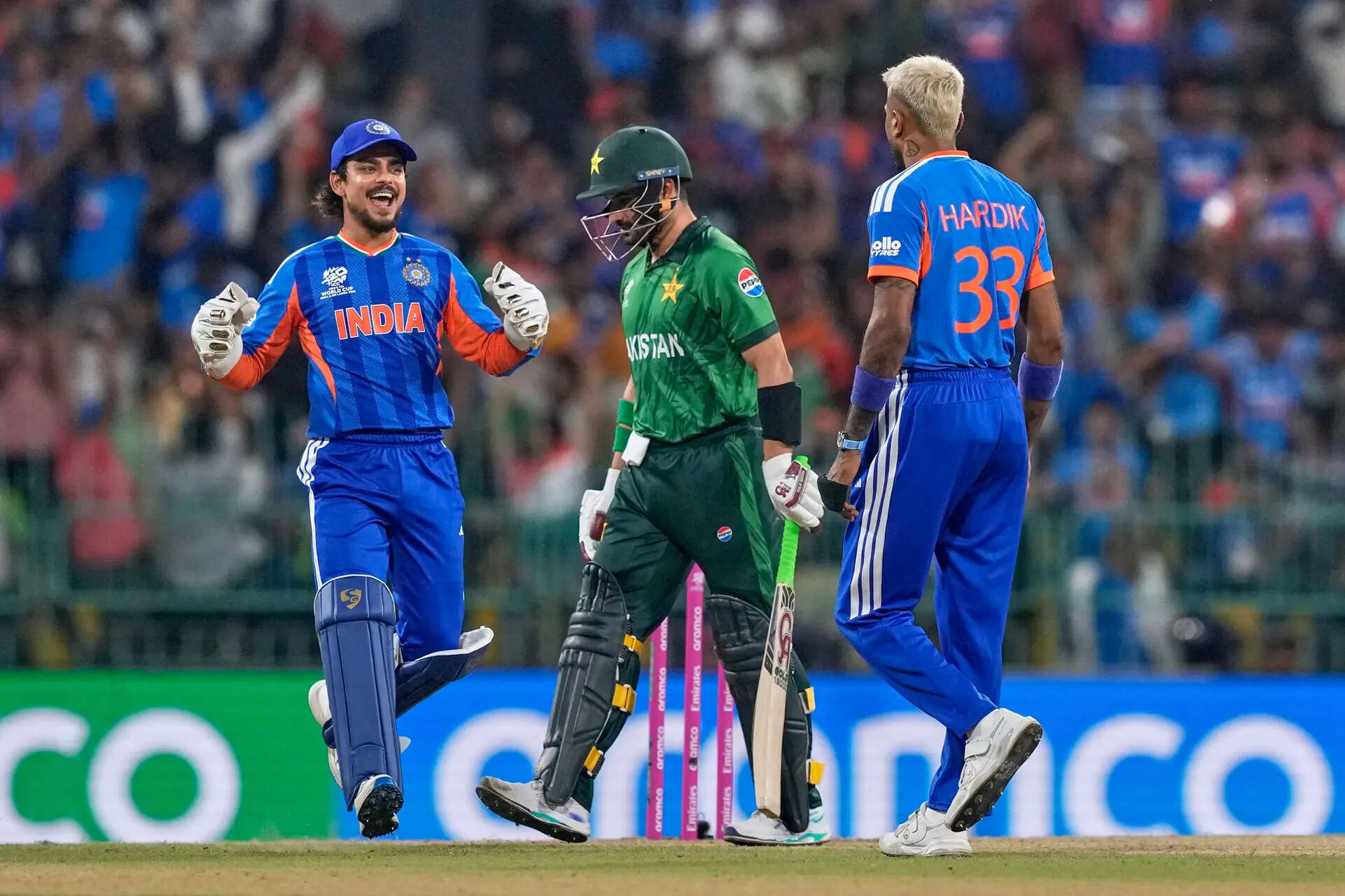
India Dominates Pakistan in ICC T20 World Cup
India achieved a decisive victory against Pakistan in the ICC T20 World Cup, with strong batting from Ishan Kishan and effective bowling securing the win.
15 Feb, 23:30 — 16 Feb, 03:40
How outlets covered this
Coverage (4 sources)
'You have to see the bigger picture': Pak captain after India defeat
Pakistan’s 61-run loss to India has put their T20 World Cup hopes at risk, with elimination possible depending on final Group A results. India have qualified for the Super Eights, while Pakistan sit third. Ishan Kishan’s 77 powered India to 175, before Pakistan collapsed for 114. Pakistan must beat Namibia and rely on other results to stay in contention.
By TOI SPORTS DESK
Read at source →Optimism gone awry
They came, they saw, they collapsed. After the hullabaloo of the boycott and “un-boycott”, after the claim of a moral victory in the immoral corridors of the ICC, there was some expectation that Pakistan’s chutzpah in cricket politics would translate onto the cricket pitch. But it was not to be. For the Pakistani fan, it is usually the expectation that kills you. Beyond the post-boycott optimism, there were genuine cricketing reasons to be optimistic this time around. The only silver lining for Pakistan now is that the outcome of this match should not stop their qualification for the next stage. In recent months, Pakistan have looked like a team getting to grips with modern T20 cricket. They rediscovered spin and are reconnected with the joy of hitting. In recent months, Pakistan seem to have rediscovered spin and the joy of hitting, but the team still have much to learn if they are to challenge the stronger nations A team and game formula has begun to emerge under the low-key technocracy of Mike Hesson. Importantly, Pakistan seem to have rediscovered themselves, and built a platform for a better future. It is worth remembering that they also started this tournament well. Yet, that platform is very much under construction, and on Sunday, India ruthlessly exposed how far it is from being finished. It is a shocking and sobering statistic, but India have now defeated Pakistan in 11 consecutive World T20 matches. The question the PCB should be asked now is: What are you going to do about this form of cricket domination? Salman Ali Agha’s team will have learnt an important lesson: you need to walk before you can run. Pakistan can walk, but breaking out too early into a sprint is inadvisable. In Colombo, Pakistan’s execution of their plan was hapless, but the plan itself was also a problem. The bowling plan failed to apply early pressure on India, and the batting plan threw the game away in the first power play. For once, only the fielding stood up to scrutiny. Dissecting the failures India’s target looked a stiff challenge, and Pakistan began in disastrous fashion. Being positive is good, but Pakistan were reckless, especially since they were losing wickets. Saim Ayub was undone by a Jaspreet Bumrah pearler, but the rest of the top order hit like they were playing tape-ball cricket on the streets of Lahore, not in an ICC showcase event against India. It was a baffling and careless effort. What adds salt to the wound is the fact that while India were competent in the field, they weren’t spectacular enough to deliver a 61-run thrashing. The parade of irresponsibility was led by Salman Agha and Babar Azam, Pakistan’s most senior top order batsmen. When Pakistan needed at least one of them to stand and anchor the innings, neither was willing to embrace the mental application required from them. The easy option was to hit out, and get out. Resistance came in the form of Usman Khan, but the pressure of losing early wickets — and the consequent impact on run rate — was too much. Usman’s rally was half-decent, at a time when something extraordinary was needed. All eyes were on the toss for evidence of a reset in the rivalry. Would the captains shake hands, the standard etiquette of cricket? They didn’t. Normal service resumed. Salman and Suryakumar barely exchanged a glance. The decision at the toss — to bowl first — looked a defensive one. What followed suggested that Pakistan had, once again, shrivelled to the occasion. Suryakumar was happy to be invited to bat. But Salman followed this decision by bowling the first over himself. It was a good one on a turning track, with the wicket of Abhishek Sharma to boot. That was as good as it got. Any genuine hopes lasted but one over. From that point on, Pakistan’s plan and senses unravelled. Kishan VS the bowling This was in large part due to the brilliance of Ishan Kishan. The small opener stood and delivered, rooted to the crease and striking powerfully. When he did dance down to the spinners, he moved decisively. For the first half of the match, it was Kishan versus Pakistan, and Kishan won. On a day of batting mediocrity, he was a class apart. Pakistan’s bowlers didn’t help themselves. Shaheen Shah Afridi and Abrar Ahmed, arguably the spearheads of our attack, were poor. Shadab Khan was also off his game. They bowled like a team going through the motions, barely adjusting to Kishan’s advance. If you can’t get the man while he’s on a rampage, the captain’s job is to get the rampager off strike. But Pakistan were stuck in a groove of needless variation. The general problem was that having backed spin, Pakistan didn’t utilise it properly. Bright sparks The pitch was taking turn off a length, and when Pakistan chose to exploit it with more classical spin bowling, it worked. Usman Tariq kept this in mind as he reeled off his freeze frame variations to valuable effect. Saim Ayub stuck to the disciplines best, though, bringing Pakistan back into the contest with Kishan’s wicket, followed immediately by Hardik Pandya’s. Pakistan’s impact player was suddenly on a hat trick. It was possibly game on. The hat-trick ball that Saim produced was perhaps the ball of the innings. Shivam Dube might have been bowled, caught or stumped, but managed to avoid each of these catastrophes. Still, Pakistan’s spinners pulled the game back, slowing a run rate of 9 an over to a mere 6-7 an over, until Afridi’s disastrous final offering allowed India to reach a formidable 175. For the Pakistan fan, the main takeaway on Sunday is the relief that they are not out of the tournament, yet. But the team have much to learn if they are to challenge the stronger nations. And even if Pakistan did not please their fans with their performance in Colombo, they at least did manage to placate Sri Lanka, India, and the ICC by honouring their tournament commitment. Published in Dawn, February 16th, 2026
By none@none.com (Kamran Abbasi)
Read at source →‘India rocked it’: Sachin hails win, Sehwag says ‘full kambal kuttai’ vs Pakistan
India secured a commanding victory against Pakistan in the ICC T20 World Cup. Ishan Kishan's powerful batting set the tone, followed by effective bowling from the Indian team. This win extended India's strong head-to-head record against Pakistan in tournaments. The team has now advanced to the Super 8 stage with an undefeated streak.
By TOI SPORTS DESK
Read at source →Fearless without being reckless: Ishan Kishan's demolition job in Colombo
On a difficult Colombo surface that aided spin, Ishan Kishan’s fearless 77 off 40 balls powered India to 175 against Pakistan. While others struggled, Kishan stayed ahead of the conditions, dismantling the middle overs with innovation and intent, producing a defining T20 World Cup innings built on clarity, courage and control.
By PRATYUSH RAJ
Read at source →